Intent-Centric Protocols: A Simpler Way to Use Blockchains

If you've ever tried to swap one cryptocurrency for another, you know the feeling. A screen full of options you didn't ask for: gas fees, slippage tolerance, liquidity routes. Each one seems like a small decision that could cost you money if you get it wrong. Something that should feel like a bank transfer ends up feeling like you're flying a plane with no training.
Intent-centric protocols exist to fix this. They represent a fundamental rethinking of how ordinary people interact with blockchains, and they're quietly reshaping the plumbing beneath decentralized finance. Here's what they are, how they work, and why they matter even if you've never touched a crypto wallet.
Problem
When you send money through Venmo or PayPal, you just say what you want: "Send $50 to Alex." You don't think about servers, payment rails, or network congestion. You describe the outcome, and the system handles the rest.
Crypto hasn't worked that way. Interacting with a blockchain has meant specifying not just what you want, but exactly how to get it, at the machine level. Choose an exchange. Set a gas price (a fee bid to get your transaction processed). Pick a slippage tolerance (how much price movement you'll accept before the trade cancels). Then hope the conditions you set are still valid by the time the transaction goes through.
This is imperative design: you give the computer explicit instructions, and it follows them to the letter, even if conditions have changed since you hit "submit." The result is brittle, intimidating, and expensive. Trades fail. Users overpay. And the complexity keeps most people on the sidelines entirely.
Idea
Intent-centric protocols flip this model. Instead of submitting machine-level instructions, you submit an intent: a signed statement expressing the outcome you're after. Something like: "I want to exchange my ETH for at least 2,000 USDC, any time in the next five minutes”. No route, no platform, no sequence of steps. Just the result you want and the boundaries you'll accept.
Think of it as the difference between giving someone turn-by-turn driving directions versus telling them the address. Same destination, very different burden on you. Once you've signed your intent, it's handed off to a network of specialized actors called solvers, who compete to find the best way to fulfill it.
Mechanics
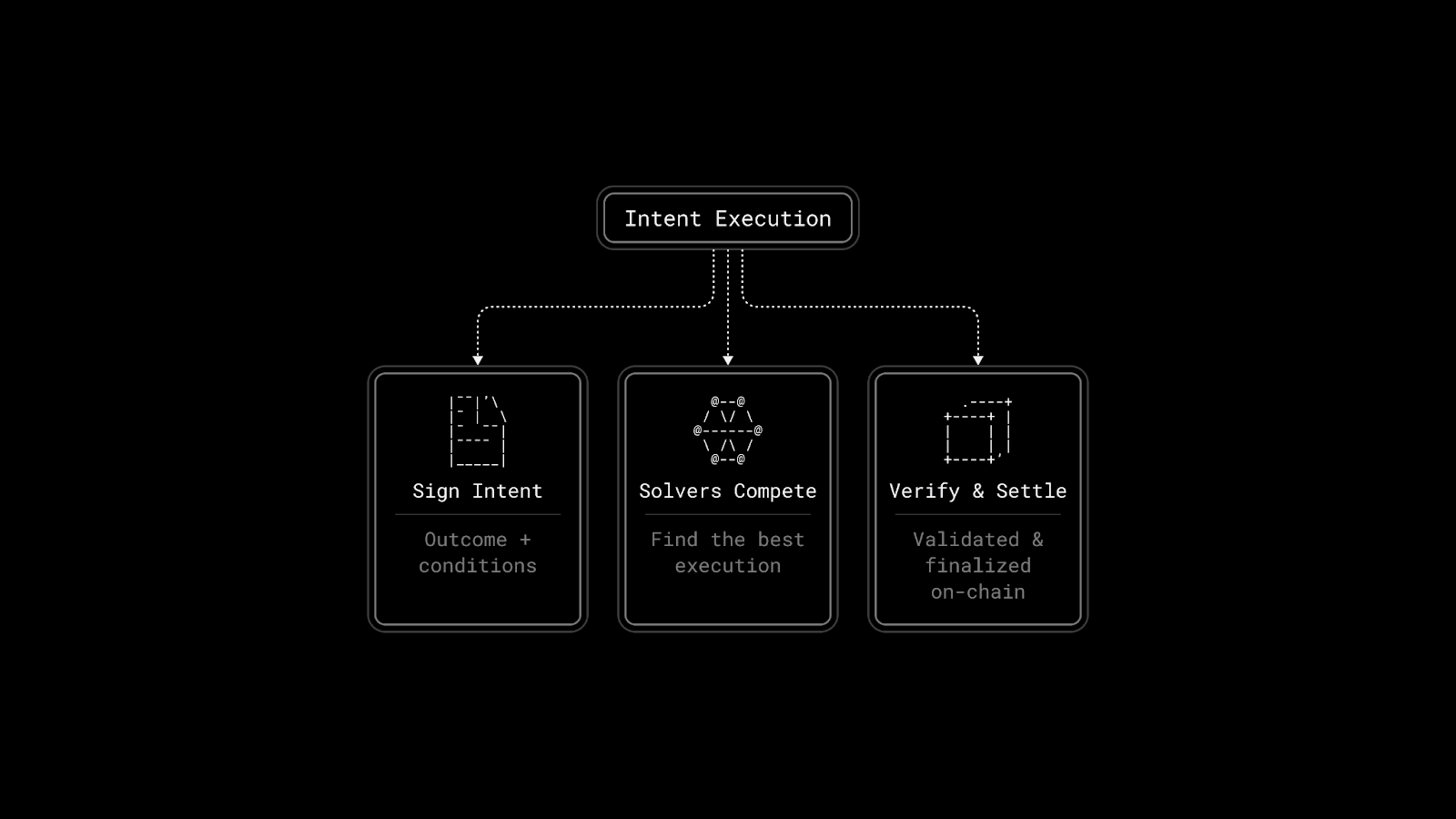
First, you sign a cryptographically secure message describing the outcome you want, including any conditions: minimum amounts, fee caps, time windows, compound rules. This isn't a transaction yet. It's a verifiable wish.
Then, a decentralized network of solvers then competes to fill it. They route across exchanges, match you peer-to-peer, tap private liquidity, or batch your intent with others. The best solution wins a reward, so competition works in your favor.
Finally, the winning solution is checked against your original conditions. If anything fails, the whole thing reverts and you lose nothing. If everything checks out, it settles on-chain. The blockchain only sees the clean result.
Protocols
Several projects are building this paradigm, each from a different angle.
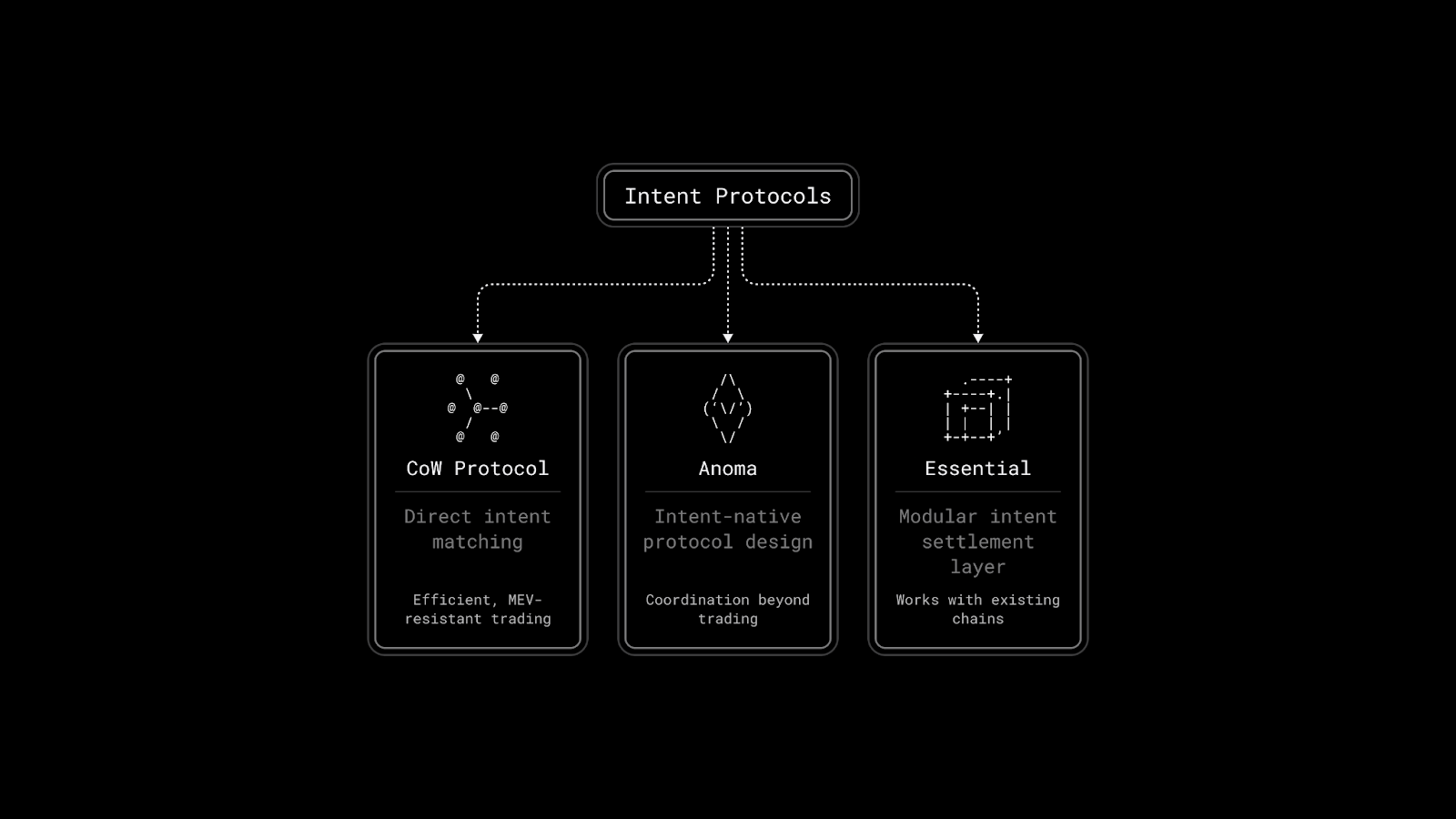
CoW Protocol (Coincidence of Wants) is the most mature. Before routing through an automated market maker, it looks for direct matches between users with compatible intents. No exchange fee, no price impact. When matches aren't available, solvers route through external liquidity. Batch settlement provides strong protection against front-running.
Anoma is the most ambitious, building an entirely new protocol from scratch with intents as the foundational building block. The vision extends beyond trading into coordination, resource allocation, and governance.
Essential takes a pragmatic, modular approach, building intent settlement as a standalone layer that existing blockchains can plug into without starting over.
In Practice
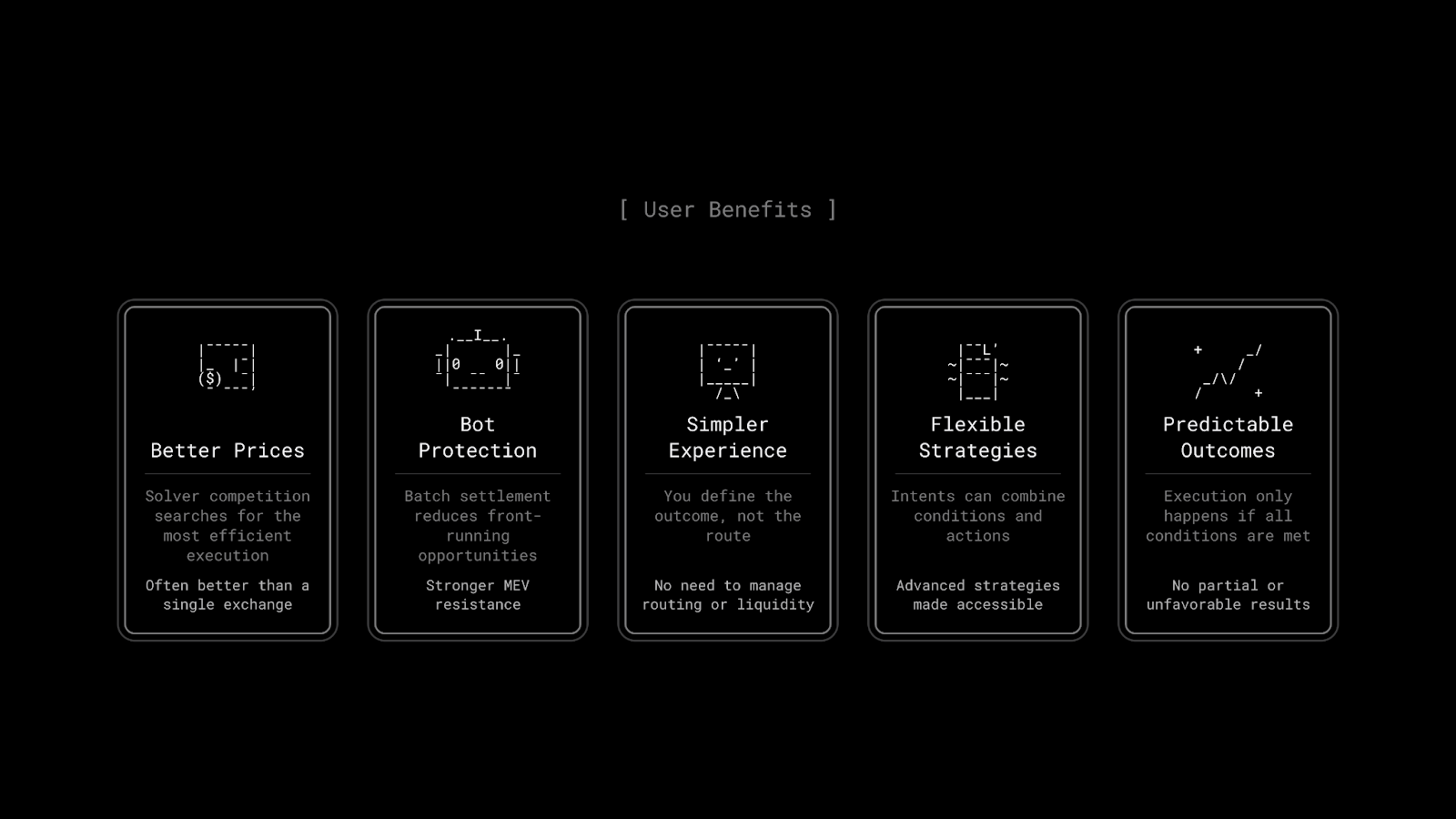
The user-facing difference is real. Solver competition consistently finds better prices than any single exchange. Batch settlement systems like CoW's make front-running structurally harder by settling trades at a uniform price. You don't need to understand liquidity pools, gas optimization, or routing logic. And because your intent only settles if every condition is met, you don't end up with transactions that went through but delivered a bad outcome because conditions shifted mid-execution.
Trade-Offs
Intent-centric protocols are promising, but they aren't a solved problem.
The solver layer introduces a new centralization risk. Competing as a solver requires serious infrastructure and capital, so a small number of sophisticated players tend to dominate. That quietly recreates some of the trust assumptions these systems are meant to eliminate. Most protocols are actively working on this, but it remains an open challenge.
Privacy is another concern. Broadcasting an intent before it's filled means revealing your preferences to the solver network before execution, creating an opening for solvers to exploit that information. It's a subtler version of the same front-running problem intents are designed to solve. Cryptographic countermeasures exist, but they're still maturing.
There's also a natural tension between expressiveness and execution: the more complex your intent, the harder it is for solvers to fill it efficiently.
Bigger Picture
Intent-centric design isn't just a UX improvement for crypto traders. It's a rethinking of the relationship between users and decentralized networks.
Today's blockchains (Ethereum, Solana, and others) were built around the assumption that users interact with the protocol directly, specifying every detail of every action. That worked for developers and enthusiasts building new infrastructure. It doesn't work for the billions of people who might one day use decentralized systems the way they use email, without knowing or caring how the pipes work.
Intents are the pipes. You describe what you want. The network figures out how. That shift has consequences well beyond any single protocol, consequences we'll explore in Part 2, where intents meet the automation layer that can bring them to life.
About Reactive Network
Reactive Network is an EVM automation layer built around Reactive Contracts — event-driven smart contracts for cross-chain, on-chain automation.
Reactive Contracts monitor event logs across EVM chains and execute Solidity logic when subscribed events occur, autonomously deciding when to send cross-chain callback transactions. This model supports conditional cross-chain state changes and continuous cross-chain workflows.
Website | Blog | X | Telegram | Discord | Docs
Build once — react everywhere!