Intent-Centric Protocols: Need for a Trigger

In Intent-Centric Protocols: A Simpler Way to Use Blockchains, we looked at how intent-centric protocols are changing the way people interact with blockchains. Instead of specifying every step of a transaction, you describe the outcome you want and let a network of solvers compete to deliver it. It's a cleaner, safer model. But it has a gap.
Intents are great at expressing what a user wants. What they don't do is watch the world and decide when to act. Someone, or something, still needs to monitor conditions, detect the right moment, and trigger execution. Today, that job falls mostly to off-chain bots and custom infrastructure. Reactive Contracts, built by Reactive Network, offer an on-chain alternative, and a natural complement to the intent-centric stack.
Missing Piece
Take a simple intent: “Sell my ETH if it drops below $1,500”. The intent is clear. Execution is solvable. But nothing activates it.
A system still needs to monitor the price and trigger execution at the right moment. In DeFi today, that’s done by off-chain keepers. It’s effective but dependent on private infrastructure, uptime, and coordination.
This is the gap: intents define outcomes, solvers handle execution, but the trigger layer remains mostly off-chain.
Reactive Contracts
Reactive Network approaches this problem by rethinking what smart contracts can do. Traditional smart contracts are passive. They contain logic, but they only execute when someone explicitly calls them, either a user signing a transaction or a bot poking them into action. They can't watch for events on their own.
Reactive Contracts invert this relationship. They subscribe to on-chain events across EVM chains and execute Solidity logic automatically when predefined conditions are met. No caller. No keeper. No cron job. The contract itself decides when to fire, based on what's happening on the blockchain.
In practice, a Reactive Contract might monitor a price feed on Ethereum, detect that a threshold has been crossed, and send a callback to a contract on Arbitrum or Base to execute a trade. It does this without relying on an off-chain server, a centralized API, or a human pressing a button.
Pairing with Intents
The connection between intents and Reactive Contracts becomes clear once you think about the lifecycle of an intent-based interaction:
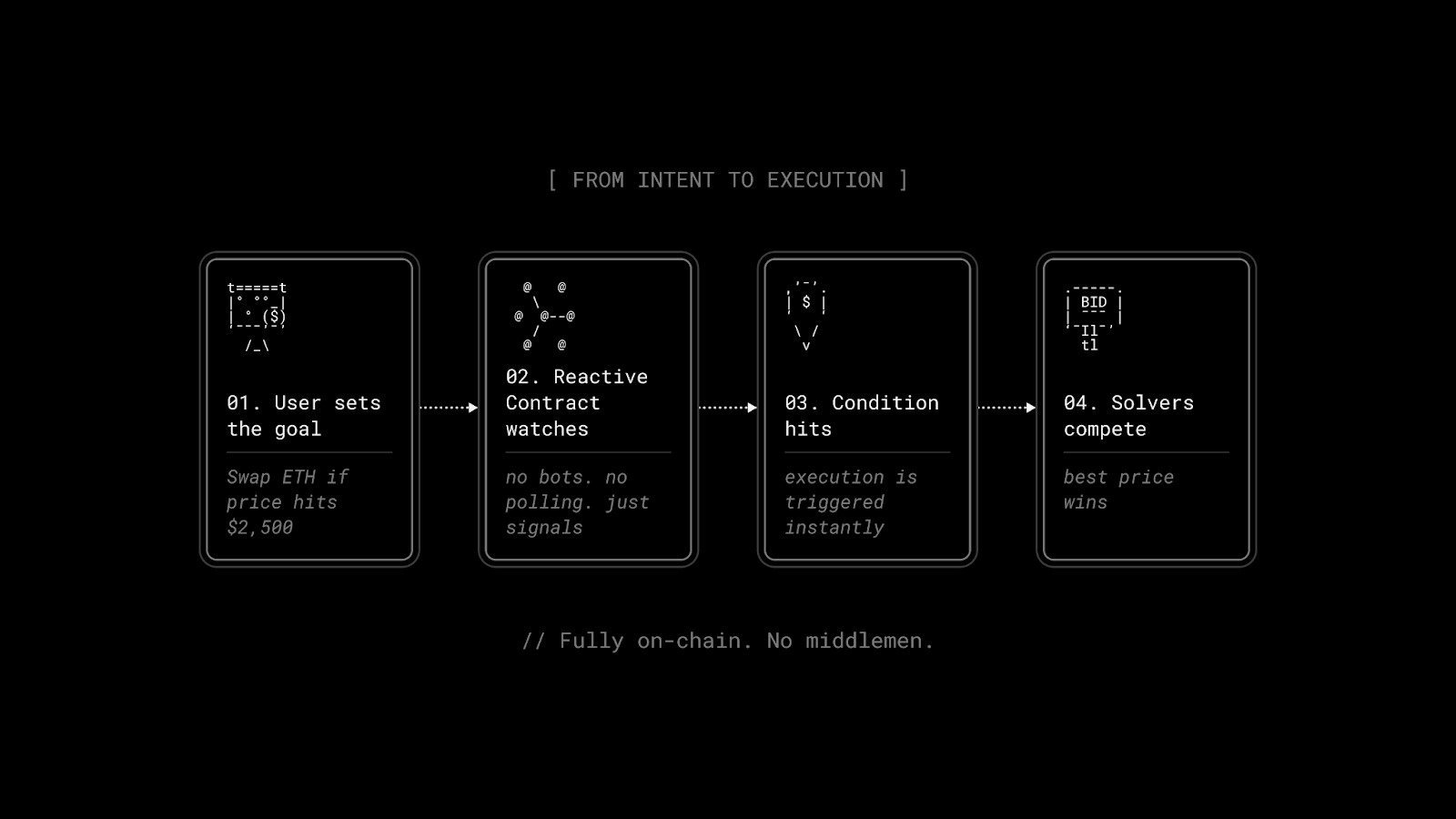
The intent layer handles what. Reactive handles when. Together, they could cover the full lifecycle of a conditional, user-defined action without requiring any off-chain infrastructure.
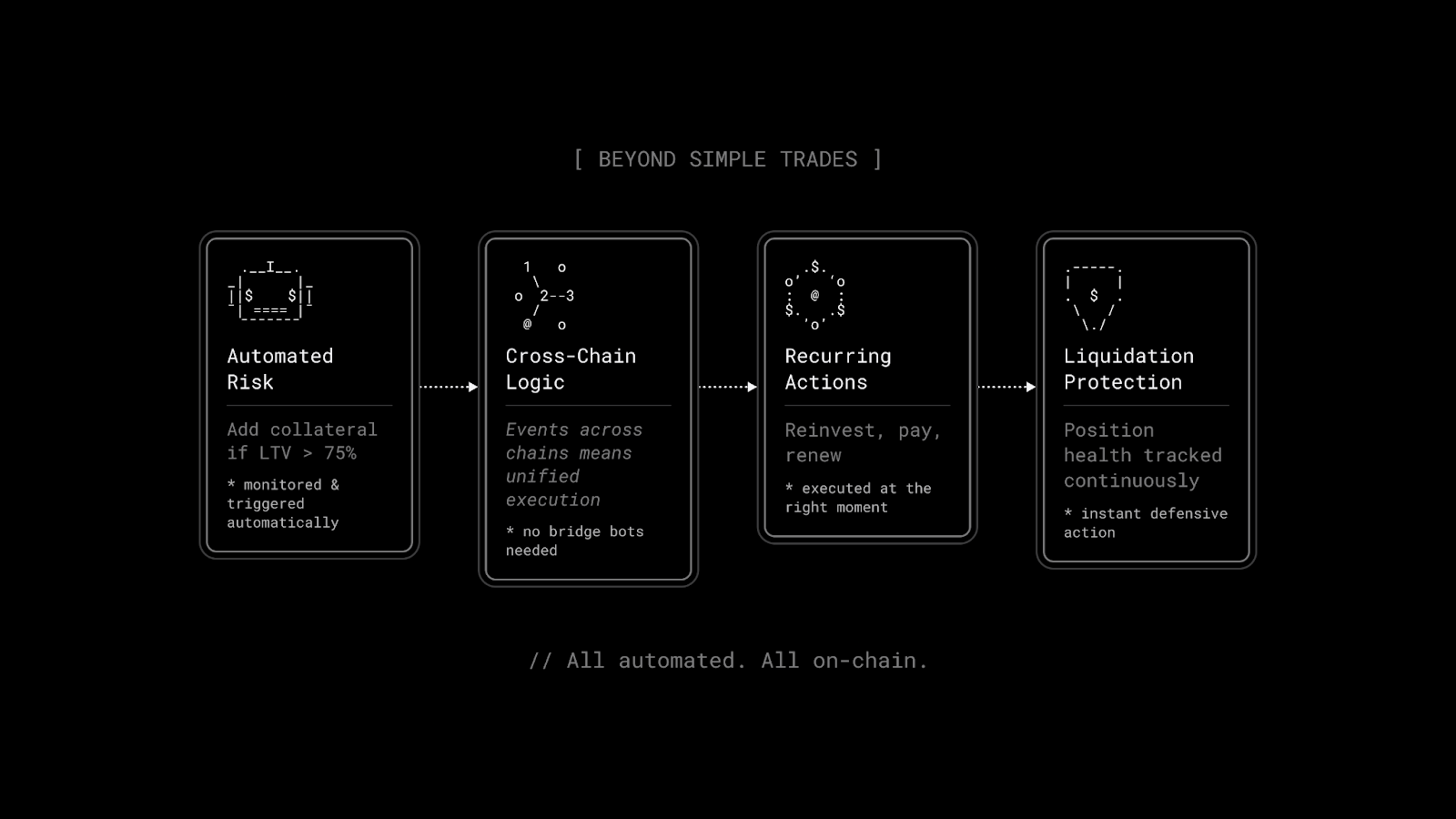
The pairing gets more interesting as intents become more expressive. A few examples of what becomes possible:
What This Replaces
To understand why this pairing matters, it helps to see what it displaces. Today, most DeFi automation depends on a patchwork of off-chain components:
Keeper bots run on private servers, polling the blockchain for conditions and submitting transactions when thresholds are met. They work, but they're centralized, opaque, and require ongoing maintenance.
Custom relayer infrastructure connects chains and triggers cross-chain actions, but each protocol typically builds its own, leading to fragmentation and redundant effort.
Centralized automation services offer convenience but reintroduce trust assumptions that decentralized systems are supposed to eliminate.
Reactive lets subscribe to events on any supported EVM chain, react from one contract, and do it without callers or keepers. For intent-centric protocols, this means the entire pipeline from user wish to on-chain settlement can remain decentralized, automated, and verifiable.
Open Questions
Although this pairing is promising, it's still early and several questions remain.
Integration complexity. Intent protocols and Reactive Network are being built independently. There's no standardized interface yet between an intent format (like ERC-7683) and a Reactive Contract subscription.
Trust model. Moving monitoring on-chain reduces reliance on private infrastructure, but introduces a new network layer into the system. Reactive’s consensus and execution guarantees become part of the overall security model.
Cost and scalability. Continuous event monitoring across multiple chains isn't free. As the number of intents and conditions grows, the computational and economic costs of the Reactive layer will need to scale respectively.
Solver-trigger interplay. If a Reactive Contract triggers an intent at a specific moment, the solver network needs to respond quickly enough to capture the intended conditions. Latency between the trigger and settlement could introduce slippage or missed opportunities, especially in volatile markets.
These engineering and design challenges are not fundamental flaws and worth naming honestly, because the value of this pairing depends on how well these pieces are actually stitched together.
Two Halves of the Same Idea
Intent-centric protocols and Reactive Contracts come from different starting points, but they converge on the same vision: a decentralized system where users describe outcomes and the infrastructure handles everything else.
Intents abstract away how. Reactive Contracts abstract away when. Together, they sketch the outline of a system where a user can set a complex, conditional, cross-chain financial strategy and walk away, knowing that the monitoring, triggering, optimization, and settlement are all handled on-chain, without bots, without babysitting, without trusting a centralized service to stay online.
About Reactive Network
Reactive Network is an EVM automation layer built around Reactive Contracts — event-driven smart contracts for cross-chain, on-chain automation.
Reactive Contracts monitor event logs across EVM chains and execute Solidity logic when subscribed events occur, autonomously deciding when to send cross-chain callback transactions. This model supports conditional cross-chain state changes and continuous cross-chain workflows.
Website | Blog | X | Telegram | Discord | Docs
Build once — react everywhere!