Liquidation Protection: Correcting DeFi’s Cliff Edge

DeFi promised a financial system that runs on code rather than intermediaries. Anyone could lend, borrow, and build positions without permission. That openness opened the door to rapid experimentation, but it also surfaced a risk that traditional finance hides behind desks and phone calls: liquidation.
Liquidation isn’t a flaw. It’s the mechanism that keeps lending protocols solvent. But as DeFi scaled, the way liquidations were triggered and executed started to look less like risk management and more like controlled demolition.
Liquidation protection didn’t appear because users wanted comfort. It appeared because the system began to break under its own speed.
This is where the story starts.
Base Mechanics
At the base level, DeFi lending follows a fixed sequence. You lock collateral. You borrow against it. As long as the position stays within bounds, nothing happens.
The sequence is intentionally rigid: it removes discretion, judgment, and negotiation in favor of solvency guarantees.
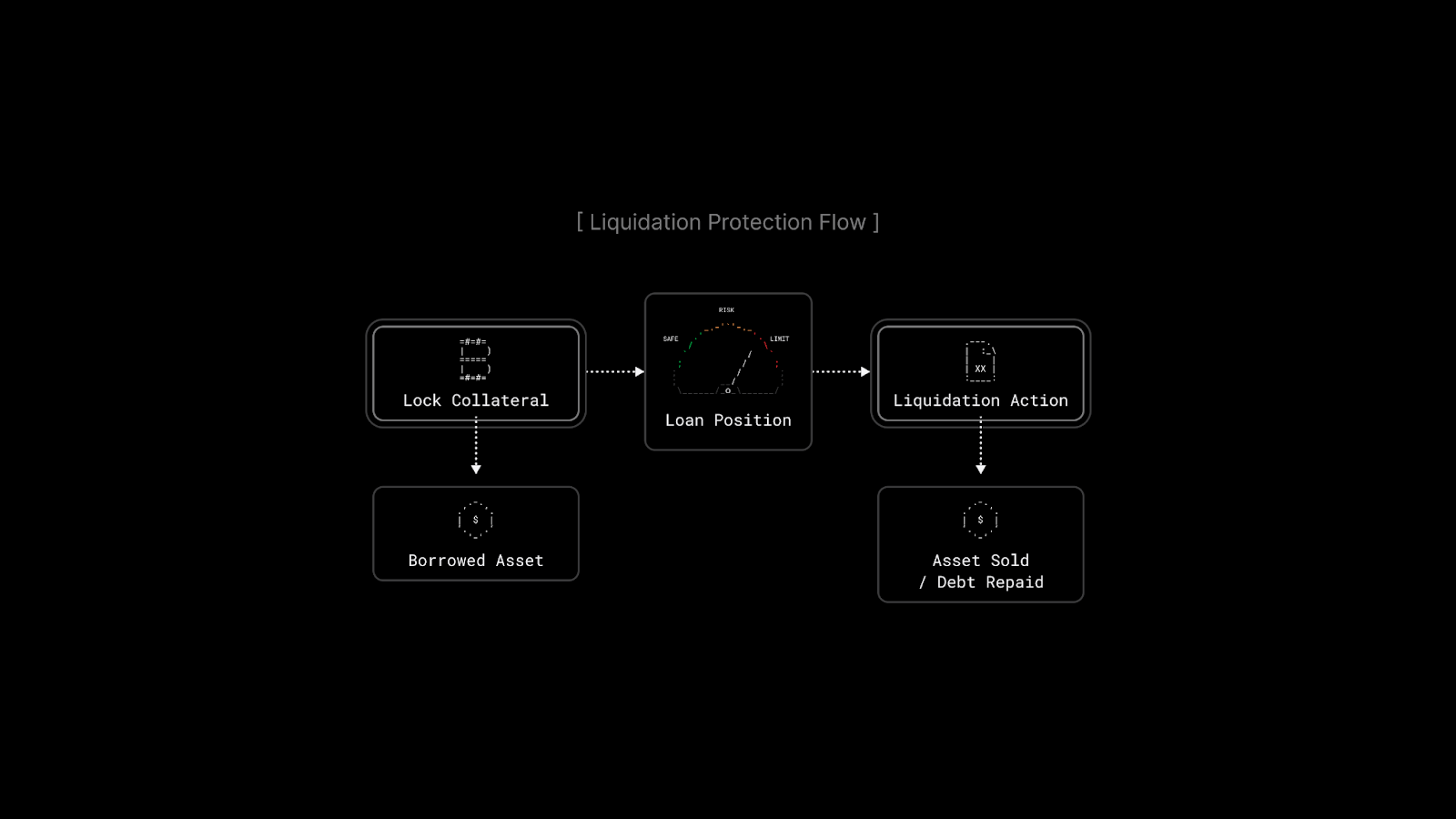
Cross the line, and the protocol acts. Collateral is sold, debt is repaid, and the position is closed, immediately, mechanically, without context. That action is liquidation.
Liquidation protection is any mechanism that tries to prevent positions from being force-closed at the worst possible moment, not by removing risk, but by reshaping how risk unfolds over time.
Instead of a single cliff edge, protection introduces slope.
Structural Friction
The original liquidation model assumed something fragile: attention. As long as users stayed close to their positions, risk felt manageable. Liquidation was a backstop, rare, avoidable, and framed as individual failure rather than systemic behavior.
Scale broke that assumption. What had been manageable through vigilance became unmanageable through volume.
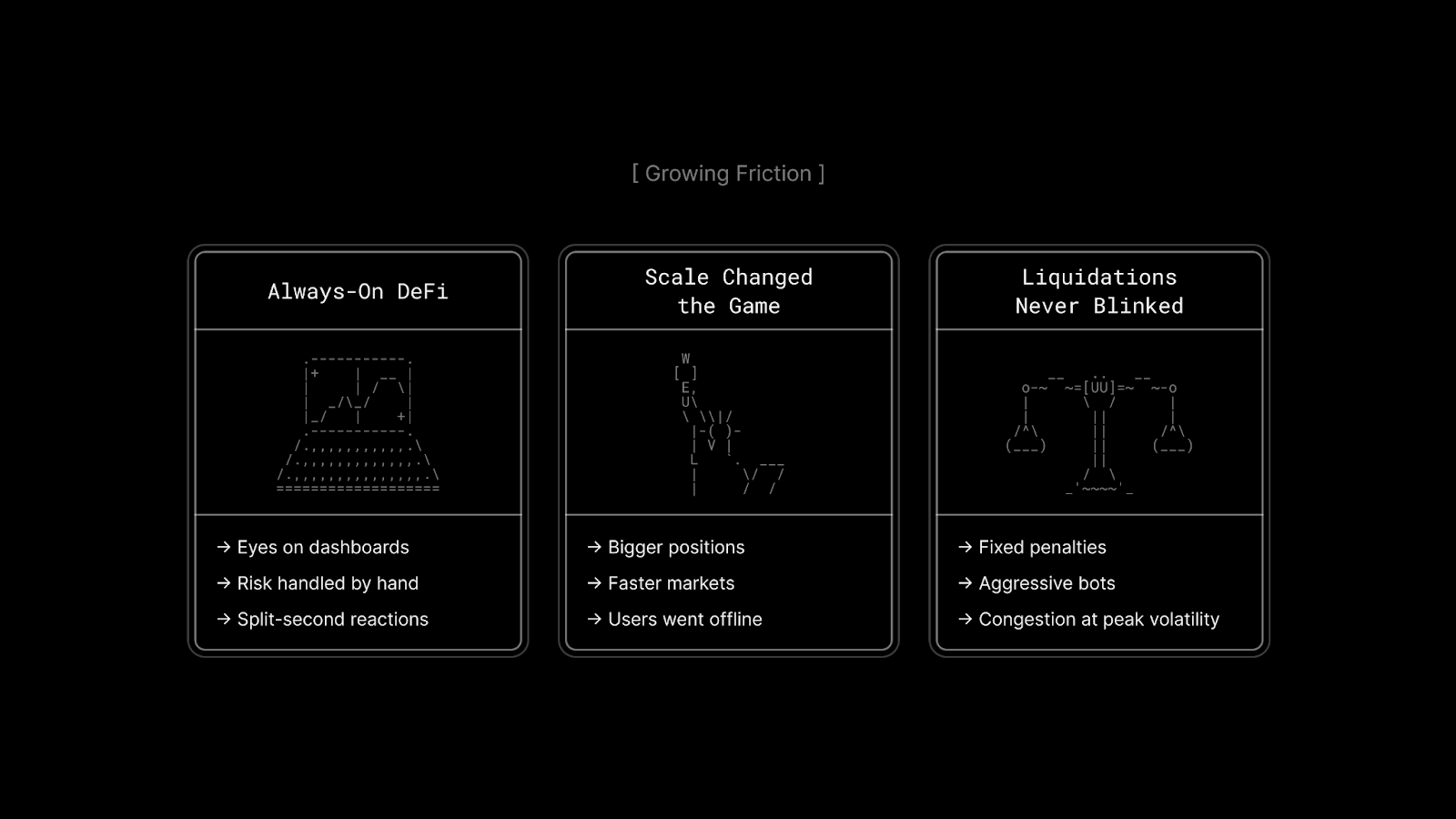
As capital grew and markets accelerated, risk stopped being something users could continuously supervise. Participation widened, attention fragmented, and reaction time became a bottleneck.
Liquidation never adapted. Its rules stayed rigid, its penalties fixed, its execution optimized for speed over context. What had been a fallback became the fastest actor in the system. The result wasn’t just more liquidations, but a structural mismatch: human-paced risk colliding with machine-paced enforcement.
That tension is where liquidation protection begins.
Binary Enforcement
Protocols tried to make risk legible. Metrics like health factor, collateral ratio, or loan-to-value reduced complex positions to a single number. That reduction made risk legible but also flattened it. Above the threshold: safe. At the threshold: dead.
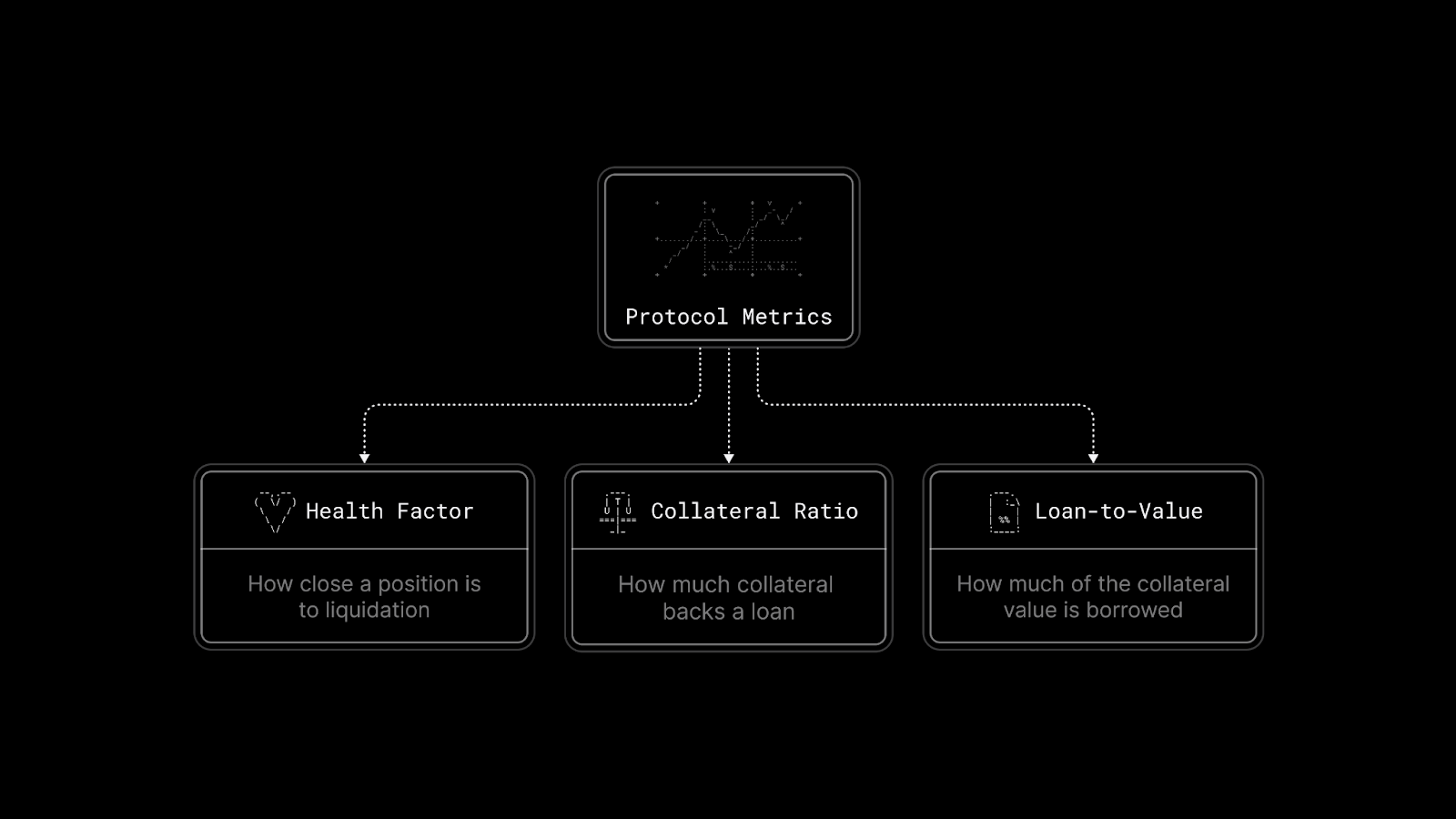
That abstraction worked until it didn’t. Risk increases continuously. Liquidation doesn’t. The system measures danger as a gradient but enforces it as a binary switch. That mismatch is the root of the problem.
Reaction Limits
The first response to this mismatch was automation, but it lived outside the system.
Alerts, keepers, and bots tried to react once danger became visible: repaying debt, rebalancing collateral, racing liquidators to the block. It worked in calm markets. It failed under stress.
When volatility spiked, everything these tools depended on broke at once: prices jumped, gas surged, block space vanished, and liquidators optimized for speed. Bots didn’t fail because they were wrong. They failed because they were late. And in a system where enforcement is instant, lateness is indistinguishable from error.
The lesson was unavoidable: protection couldn’t sit on the sidelines anymore. Instead of watching risk and reacting after the fact, protection had to:
- Be always active
- Trigger on events, not polling intervals
- Execute by rules, not races
This marked a philosophical change. Liquidation protection stopped being an accessory and started becoming infrastructure. Risk no longer had to end in a sudden stop. Positions could adjust as danger emerged.
The binary world of safe or liquidated began to crack.
From Cliffs to Slopes
Liquidation protection didn’t emerge as a feature. It emerged as a correction.
DeFi lending was built on clean rules and hard thresholds, but it inherited an assumption it couldn’t scale: that humans would stay close to risk. As markets accelerated and capital grew, enforcement outpaced attention. Liquidation became faster than judgment, sharper than context.
The result wasn’t simply more failures. It was a system where risk evolved gradually, but consequences arrived all at once.
Liquidation protection marks the moment that mismatch became impossible to ignore. It represents a shift from reactive enforcement to continuous control, from cliff edges to slopes.
This isn’t the end of the story. It’s the point where DeFi lending had to choose between speed and structure.
About Reactive Network
Reactive is an EVM-compatible execution layer for dApps built with Reactive contracts. These contracts differ from traditional smart contracts by using inversion-of-control for the transaction lifecycle, triggered by data flows across blockchains rather than by direct user input.
Reactive contracts listen for event logs from multiple chains and execute Solidity logic in response. They can determine autonomously when to transmit data to destination chains, enabling conditional cross-chain state changes. The network delivers fast and cost-effective computation via a proprietary parallelized EVM implementation.
Website | Blog | Twitter | Telegram | Discord | Reactive Docs
Build once — react everywhere!