Liquidation Protection: Designing Around the MEV Funnel

The first phase of DeFi lending broke under speed: systems that assumed human attention and reaction time were overtaken by markets that moved faster than users could respond. The second broke under incentives: liquidation began rewarding those who could trigger and capture it, not those who reduced risk.
As liquidation became fast, deterministic, and frequent, it stopped being just a safety mechanism. When value appears at a known moment, behavior organizes around capture. It became a point where value reliably appeared — and where competition naturally followed.
That competition has a name: MEV. Understanding liquidation protection without understanding MEV is like studying traffic accidents without looking at road design. The collisions aren’t random. They happen where the system concentrates pressure.
Pressure Points
MEV, or Maximal Extractable Value, is the profit captured through execution ordering and timing. A simpler way to think about it is traffic. Imagine an intersection with no traffic lights. Cars arrive from every direction. There are rules, but no enforced order. Whoever moves first gets through.
Now imagine that, at certain moments, the intersection must open because something valuable is passing through. Everyone can see when it’s about to happen. Everyone knows there’s an advantage to being first. Soon, drivers don’t just pass through. They wait nearby. They accelerate early. They compete for position.
Visibility turns opportunity into coordination. That behavior isn’t reckless driving. It’s the predictable outcome of the intersection’s design. MEV works the same way. Whenever a system releases value at a known moment, competition concentrates around execution and ordering. Liquidations are one of the clearest places where this happens.
MEV Funnel
Liquidation doesn’t attract MEV by accident, it collapses value into a single executable moment. Hard thresholds, forced actions, known rewards, and permissionless execution don’t operate independently. They collapse into a single moment: the liquidation event. When that moment arrives, value is released predictably and mechanically.
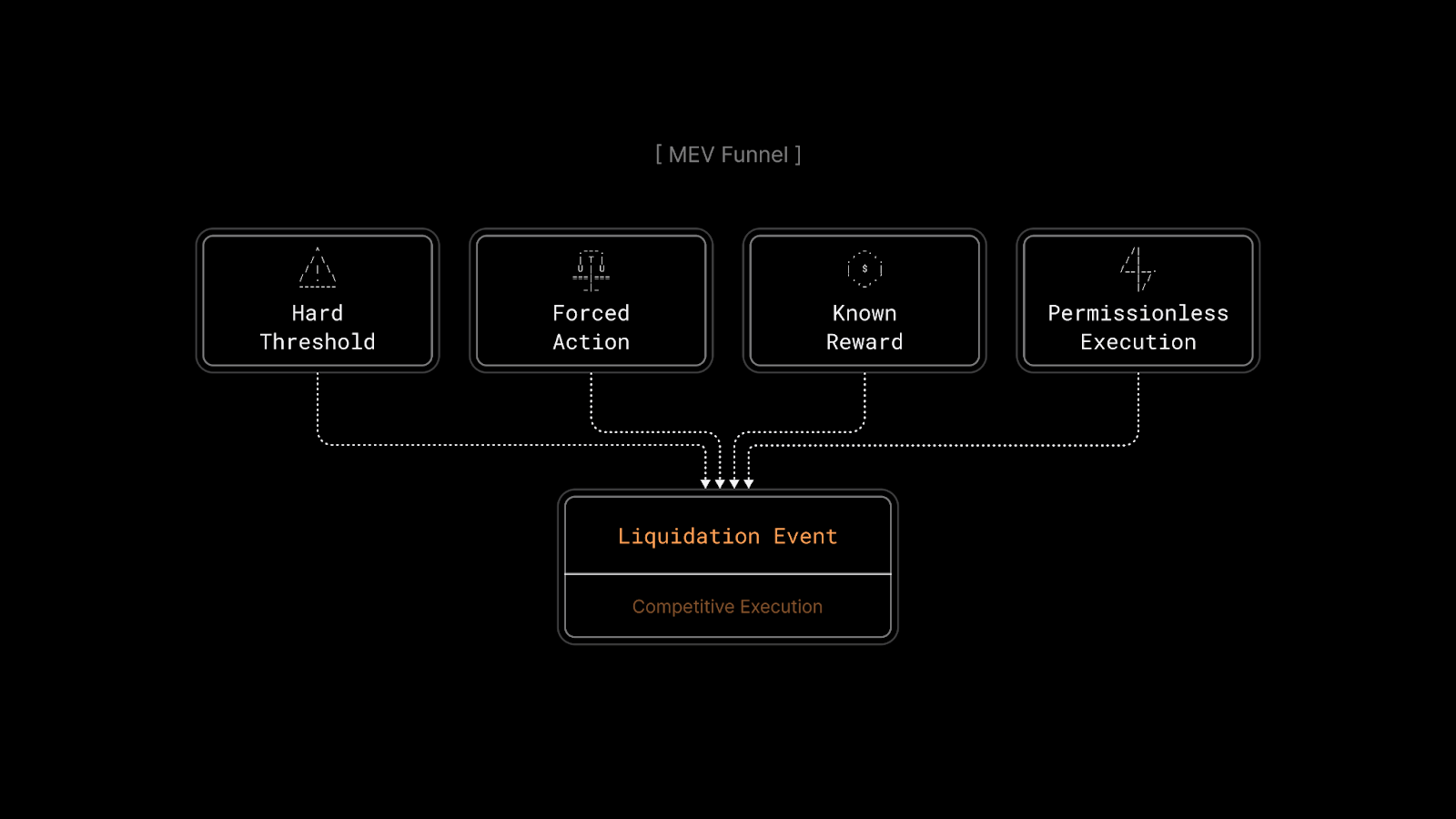
At that point, uncertainty disappears. What remains is timing. Once a position becomes liquidatable, the system no longer asks what should happen. It asks who gets there first. Execution turns competitive by design.
This isn’t exploitation. It’s incentive alignment. When value is funneled into a single, deterministic event, speed becomes strategy. Liquidation stops being about resolving risk and starts being about winning the narrowest part of the funnel.
Designed Outcomes
It’s tempting to treat liquidation MEV as an unfortunate side effect of open blockchains. But the dynamics are not accidental. Hard liquidation encodes a specific philosophy:
- Risk is tolerated until a line is crossed
- Enforcement happens all at once
- Resolution is externalized to whoever executes fastest
Those choices collapse resolution into a single moment. MEV simply flows toward that concentration. In other words: liquidation MEV is not a bug in the execution layer but rather a consequence of the liquidation model itself.
Feedback Loop
Once MEV enters the picture, liquidation stops being a single event and starts behaving like a system.
Volatility pushes positions toward their limits. As more positions cross liquidation thresholds, each liquidation releases value at a predictable moment, drawing in competition. That competition raises execution pressure: higher gas, tighter timing, more aggressive strategies. Forced sales accelerate, slippage increases, and price moves intensify. The result feeds back into volatility.
What emerges is a closed loop: volatility creates risk, risk triggers liquidations, liquidations intensify competition, and competition feeds volatility.
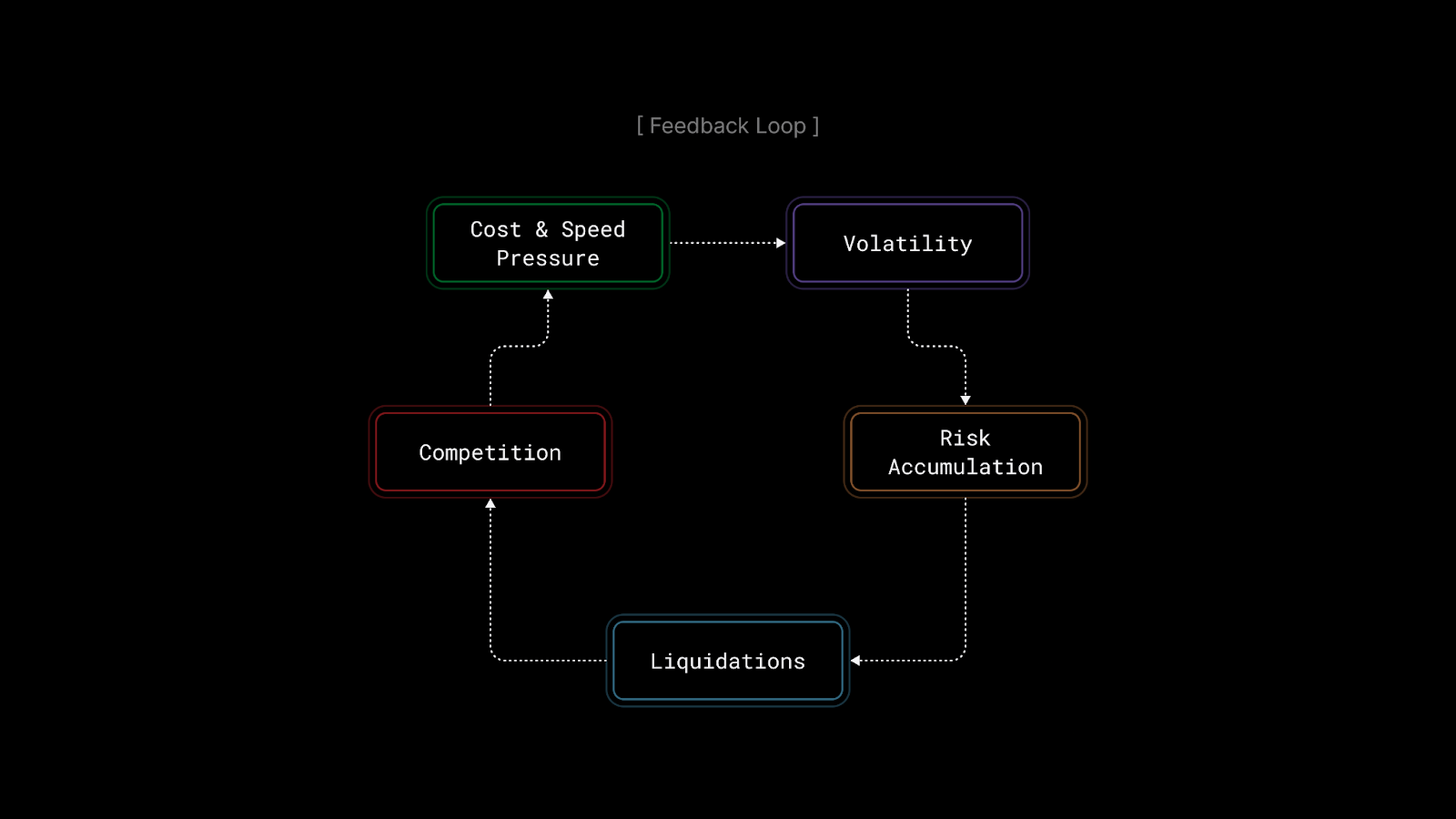
At this point, liquidation is no longer primarily about resolving insolvency. It becomes a mechanism for extracting value under stress, precisely when the system is least able to absorb it.
Protection, then, isn’t just about saving individual positions. It’s about introducing friction into a loop that otherwise accelerates itself.
Existing Protection Approaches
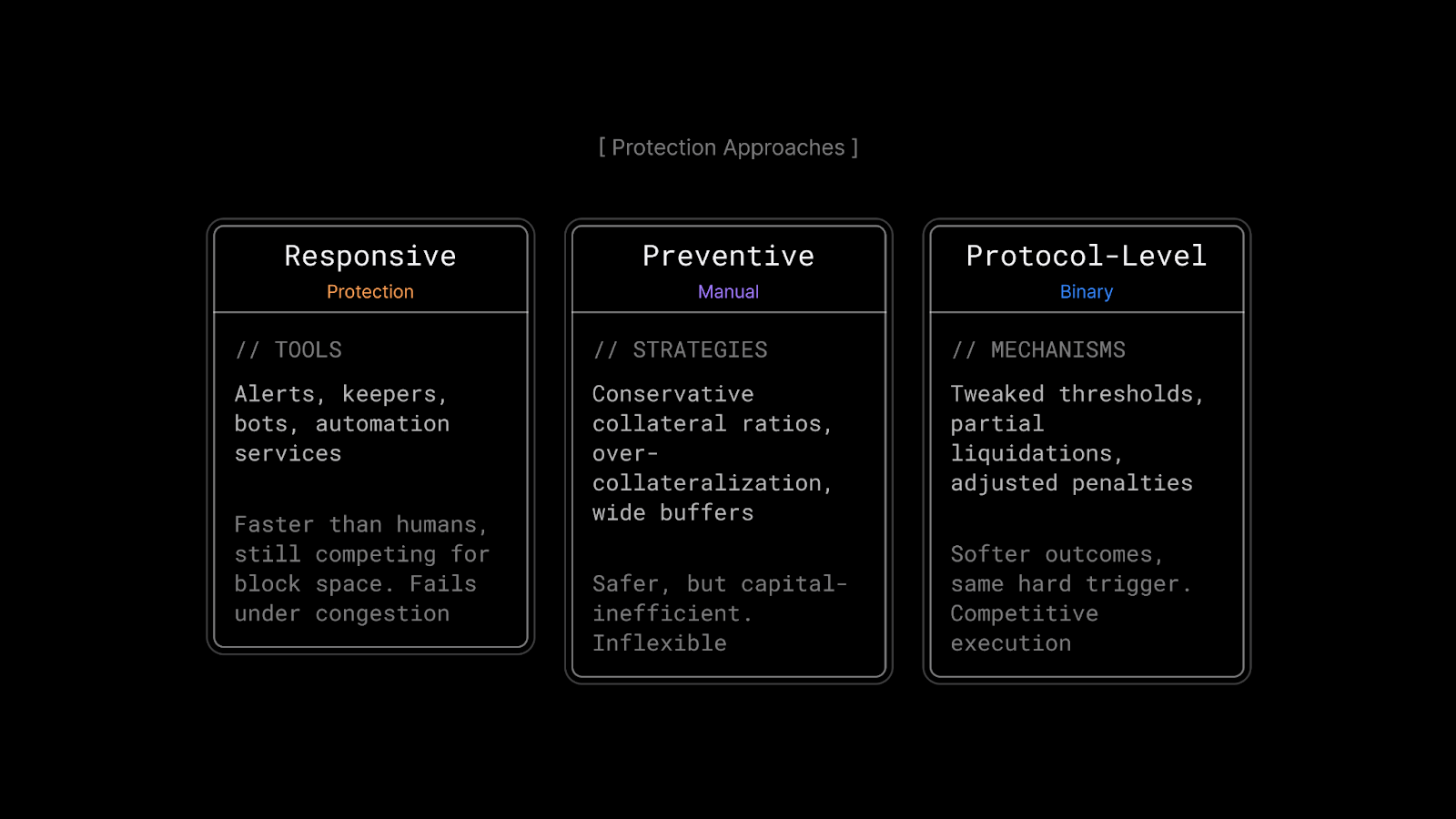
These approaches differ in where they operate: outside the protocol, at the user level, or inside the system itself. What they share is more important than what separates them.
All of them still depend on the same moment: the liquidation trigger.
Some try to react faster. Others try to stay farther away. Some soften what happens after the line is crossed. None change the fact that risk accumulates until a hard boundary is reached and that value is released all at once.
As long as liquidation remains a single, competitive event, protection can only reduce damage at the margins. The underlying incentive stays intact: a predictable moment where speed decides the outcome.
That’s the ceiling every existing approach eventually hits.
Rethinking Liquidation
By this point, the issue is no longer whether liquidation protection is needed. The real question is whether liquidation should remain a single, adversarial event at all.
Hard liquidation treats every failure the same way, regardless of speed, context, or recoverability, assuming enforcement must be immediate and absolute. But systems that operate at machine speed don’t fail cleanly. They drift. They oscillate. They recover if given time.
MEV didn’t corrupt DeFi liquidations. It revealed their incentives.
What looked like adversarial behavior was simply the system responding to rigid thresholds and hard defaults. Liquidation protection evolved to reduce losses, but it hasn’t changed the shape of liquidation itself. As long as liquidation remains a cliff, competition will continue to cluster at the edge.
That leaves a design question, not about speed or incentives, but about structure: what happens if liquidation stops being an event, and starts becoming a process?
About Reactive Network
Reactive is an EVM-compatible execution layer for dApps built with Reactive contracts. These contracts differ from traditional smart contracts by using inversion-of-control for the transaction lifecycle, triggered by data flows across blockchains rather than by direct user input.
Reactive contracts listen for event logs from multiple chains and execute Solidity logic in response. They can determine autonomously when to transmit data to destination chains, enabling conditional cross-chain state changes. The network delivers fast and cost-effective computation via a proprietary parallelized EVM implementation.
Website | Blog | Twitter | Telegram | Discord | Reactive Docs
Build once — react everywhere!