Performance Race: Beyond the Trilemma

When discussing block time, TPS, and finality, remember that none of these metrics exist in isolation. They interact, conflict, and force difficult choices. Every network is a bundle of tradeoffs, and understanding those tradeoffs helps make sense of why hundreds of different blockchains exist, each claiming to be better than the others.
This is the fifth and final article in Performance Race, a five-part series exploring how blockchains pursue speed without compromising their principles. It’s high time to put all the puzzle pieces together.
To catch up, refer to the previous articles:
Part 1: Performance Metrics →Part 2: Block Time →
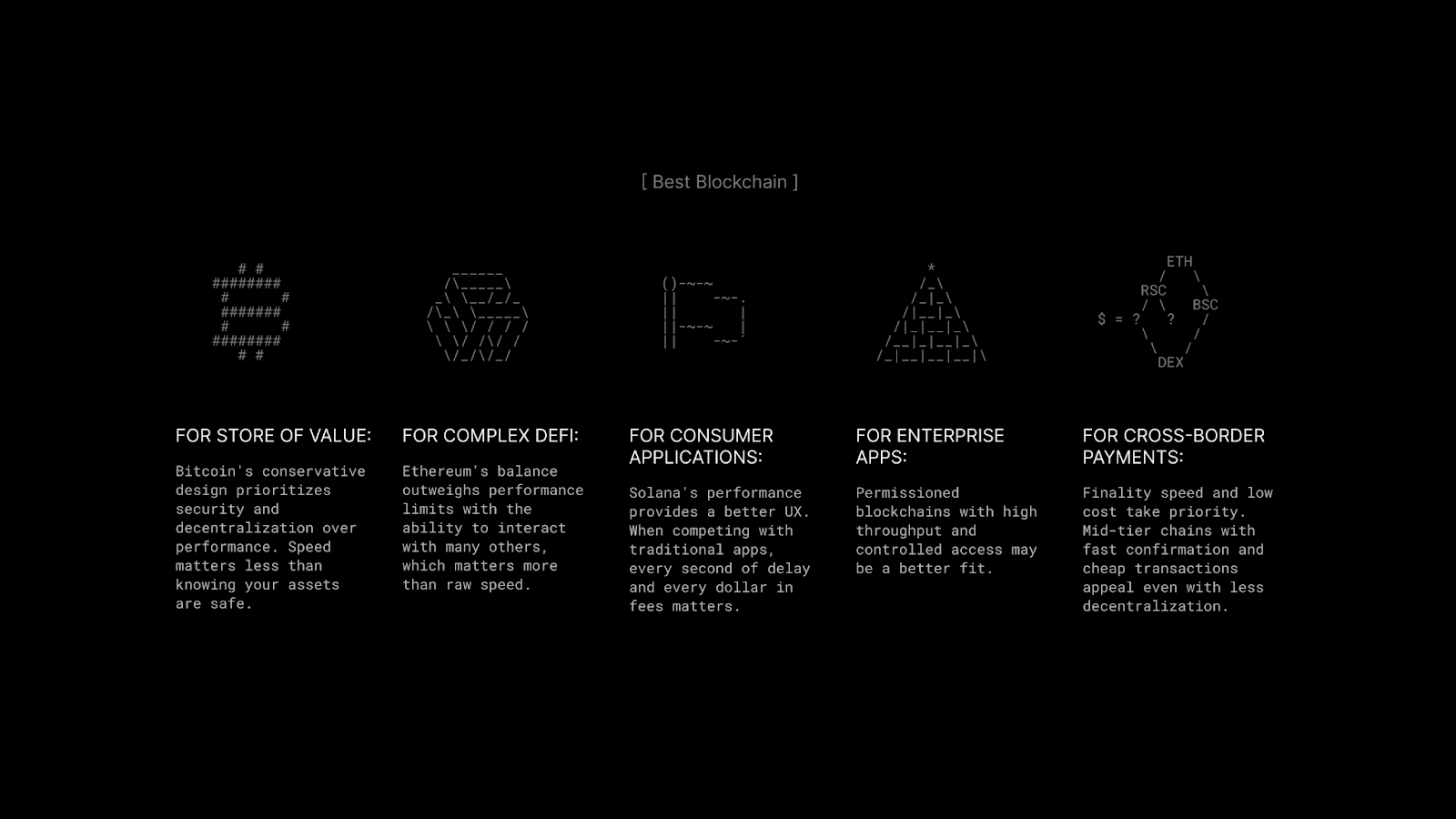
Best Blockchain
What is the best blockchain? A question that should always be followed by: best for what. The answer depends entirely on your goals. The image below is not prescriptive, but rather a perspective for considering the tradeoffs:
None of the blockchain trilemma tradeoffs are permanent. As technology evolves:
- Ethereum continues toward sharding to raise TPS throughput without sacrificing decentralization
- Bitcoin developers explore layer-2 to support more complex use cases while preserving the base layer’s conservative design.
- Solana works on stability upgrades to address its outage history while maintaining performance advantages.
- New consensus designs are regularly proposed, each claiming to optimize the tradeoff space differently. Some will deliver on their promises, others will reveal unexpected problems.
When one chain proves a certain combination of properties is achievable, others adapt or risk obsolescence.
Behind the Marketing
Every blockchain project claims to have solved the blockchain trilemma. They haven't. They've made different tradeoffs and are marketing their choices as universal wins. When evaluating blockchain claims, ask the right questions:
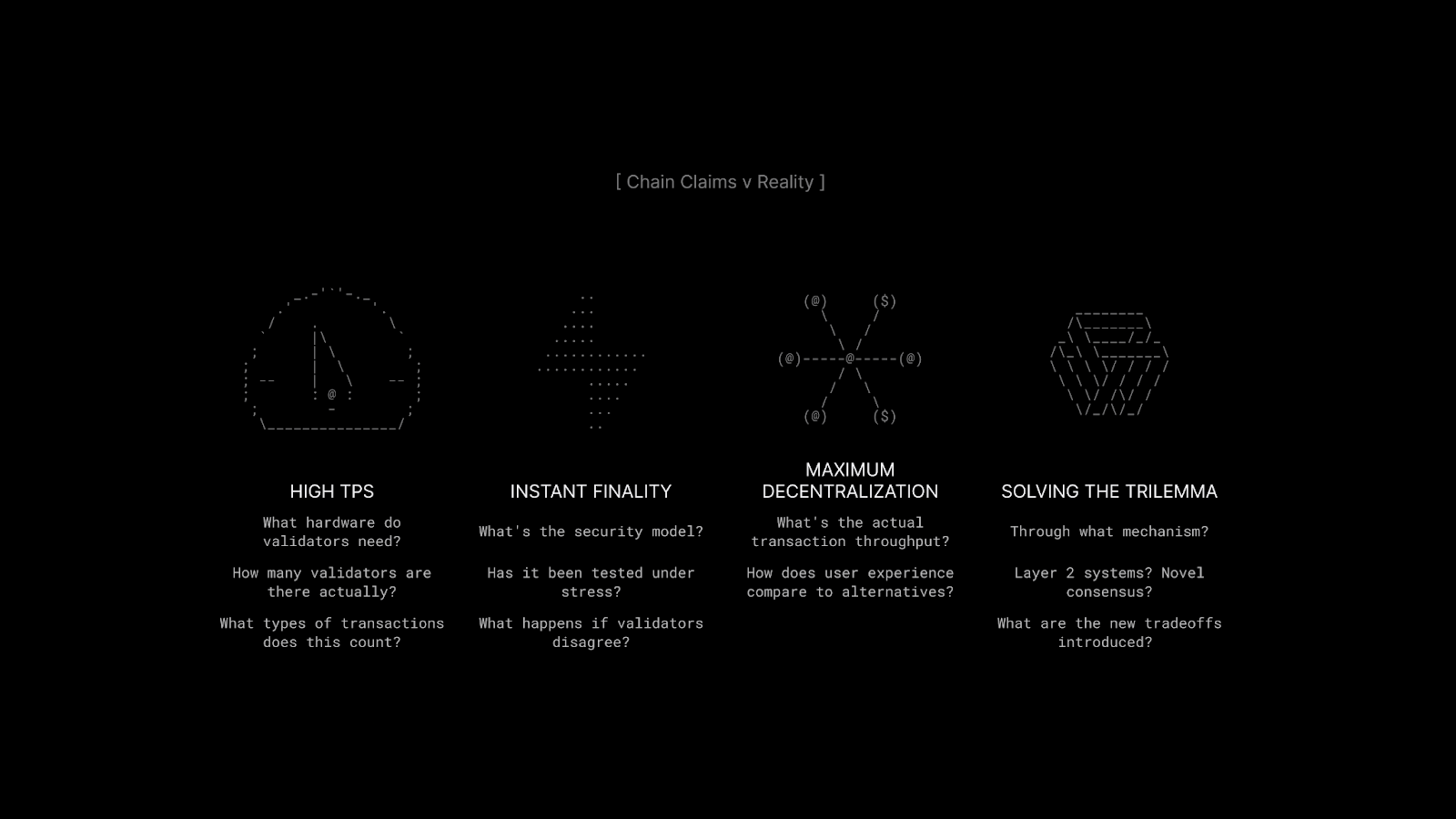
Honest projects acknowledge their tradeoffs explicitly. Less honest ones paper over them with buzzwords and marketing.
Choosing a blockchain is like picking the right vehicle for a journey. Using a Formula 1 car for a cross-country road trip seems a dubious idea, same as taking a minivan to a racetrack.
If you're building an application, consider:
- What performance does your application actually require?
- How important is decentralization to your users?
- Do you need to integrate with existing ecosystems?
- Can you use layer-2 solutions to get the benefits of both security and performance?
If you're investing or speculating, understand that different blockchains can succeed in different niches. This isn't a winner-take-all market. Bitcoin can be digital gold while Ethereum hosts DeFi while Solana centers on consumer apps.
SWIFT & Linea
In September 2025, SWIFT made a surprising move: partnering with ConsenSys and over 30 major banks to launch a blockchain-based settlement system on Linea, ConsenSys's layer 2 network. Instead of being disrupted, SWIFT is integrating the tech into their existing infrastructure.
The old story was about blockchain replacing traditional finance. The new reality is convergence. Payments now start on familiar rails for compliance and security, then settle instantly using blockchain technology.
This hybrid approach might potentially become the standard. Major players like Citi are launching real-time cross-border platforms, and analysts predict blockchain will handle a quarter of global settlements within years.
Plasma & Stablecoins
Stablecoins are also entering the race. That same September, Plasma launched its mainnet with $2 billion in stablecoin liquidity, instantly becoming one of the top 10 blockchains by stablecoin supply. Backed by Tether, Plasma is a blockchain built exclusively for moving stablecoins at scale.
The numbers tell the story. Stablecoins settled over $22 trillion in 2024, surpassing Visa and Mastercard combined. But the infrastructure supporting this volume remains fragmented and expensive. Plasma addresses this issue by offering zero-fee USDT transfers in a system stripped down only to stablecoin transactions.
A pattern appears: infrastructure is specializing. General-purpose blockchains are giving way to networks designed for specific institutional use cases. As stablecoins become the default for cross-border payments, purpose-built infrastructure matters more than ever.
Closing Thoughts
No single article can fully capture the complexity of blockchain performance design. What matters is understanding that every blockchain is shaped by compromises. Faster block times often reduce certain forms of security. Higher TPS commonly comes at the cost of decentralization. Instant finality relies on trust assumptions that differ from probabilistic finality.
Successful blockchains will be the ones that intentionally select tradeoffs aligned with their target use cases and communicate those decisions openly. Projects that overpromise, conceal weaknesses, or optimize for flashy metrics that don’t match users’ needs will eventually fall behind.
Block time, TPS, and finality aren’t just numbers on a spec sheet but lenses into design choices. They reveal what each blockchain values and what it is willing to sacrifice.
About Reactive Network
Reactive is an EVM-compatible execution layer for dApps built with Reactive Contracts (RCs): a different beast from traditional smart contracts. Instead of waiting for user-triggered transactions, RCs use inversion of control, responding automatically to data flowing across EVM chains.
They listen for event logs on multiple chains, react with Solidity logic, and decide when to transmit updates to destination chains. This enables conditional cross-chain state changes without direct user prompts. Reactive runs on a parallelized EVM implementation for fast, low-cost execution.
Website | Blog | Twitter | Telegram | Discord | Reactive Docs
Build once — react everywhere!