Privacy Paradox: Where Reactive Contracts and ZK Tech Collide

What happens when contracts that need to see everything meet technology designed to conceal nearly all information?
Reactive Contracts aren’t simply idle until invoked. Instead, they observe the entire crypto ecosystem ready to spring into action the moment something interesting happens. It’s essentially giving your contracts a distributed nervous system spanning every blockchain.
Meanwhile, zero-knowledge (ZK) technology takes the opposite stance. It asks a radical question: what if correctness matters, but data doesn’t? Instead of exposing inputs, balances, or identities, ZK systems rely on mathematical proofs that assert “this rule was followed” without explaining how or by whom. Validity without visibility.
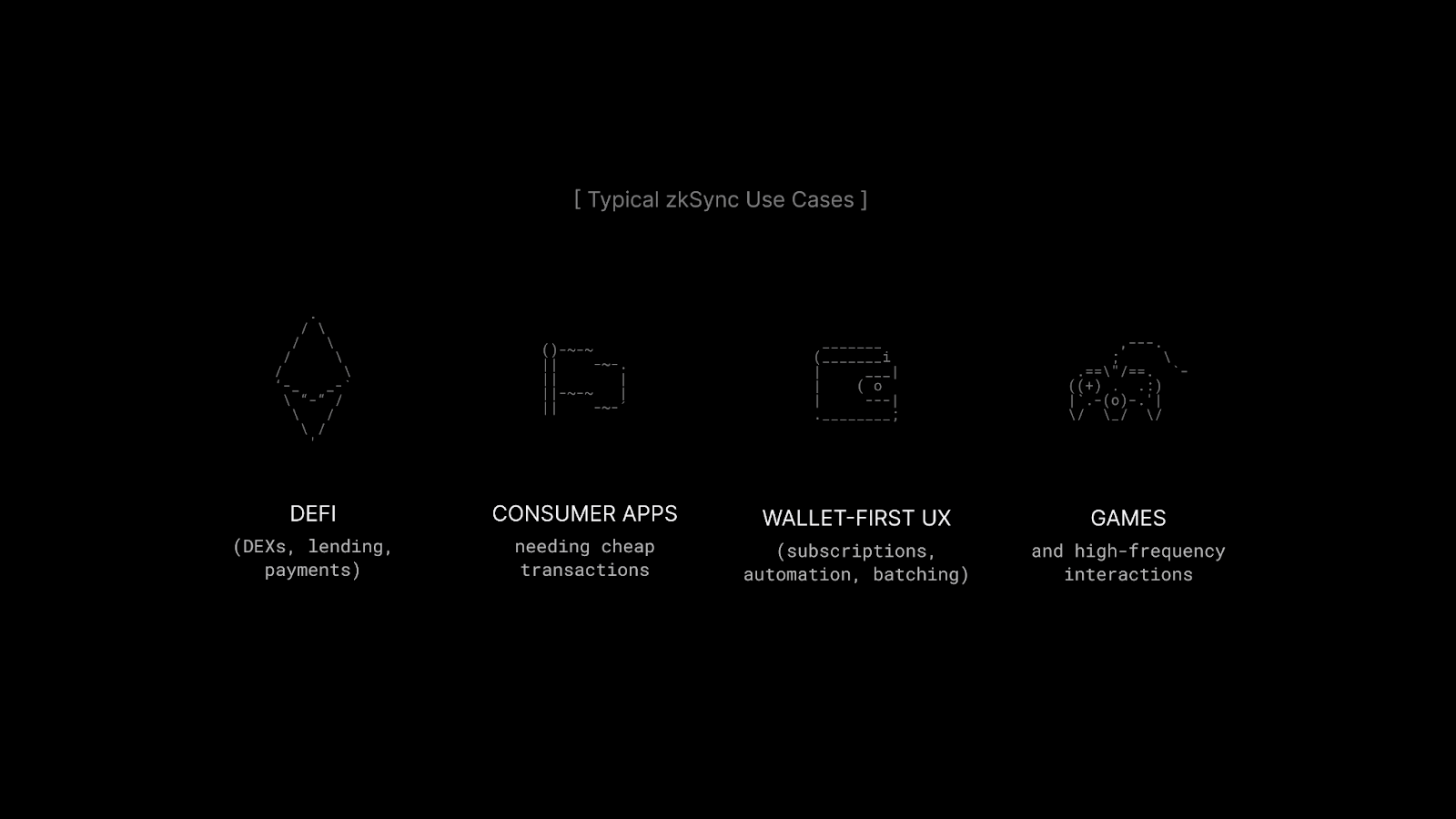
One of the most prominent embodiments of this idea is zkSync, a ZK rollup built on Ethereum. It executes transactions off-chain, compresses them into succinct cryptographic proofs, and submits those proofs to Ethereum for verification. The base chain (Layer 1) doesn't replay the logic , it only checks that the math holds.
So... can these two coexist?
Fundamental Tension
Imagine you're at a party. A Reactive Contract is the hyper-aware friend who watches the room: "Oh, Alice just walked in.. time to start the music!" But zk systems turn the environment into a masquerade, where everyone communicates through sealed envelopes. Actions are real, but identities and details are intentionally hidden.
In zkSync’s case, this privacy is not accidental, it’s structural. Transactions are bundled, state transitions are proven rather than replayed, and most intermediate details never touch Layer 1. What Ethereum sees is a proof that everything was valid, not what actually happened.
If everything is obscured, what exactly can the Reactive Contract react to?
This isn't merely a minor implementation challenge. It reflects a conceptual collision: systems designed around maximal observability versus systems optimized for minimal disclosure.
Practical Viability
Here's where the paradox softens.
Reactive Contracts may not require full transparency. They may only need specific signals, narrow, well-defined facts that indicate something meaningful occurred.
Think of a nightclub bouncer. They don’t need your entire life story, transaction history, or social graph. They only need confirmation that you’re of legal age and that the entry fee has been paid. Zero-knowledge proofs excel precisely at this kind of validation: proving conditions without exposing context.
This introduces the idea of selective transparency. In practice, zkSync (or similar ZK systems) could expose public commitments or events that carry semantic meaning without leaking private data.
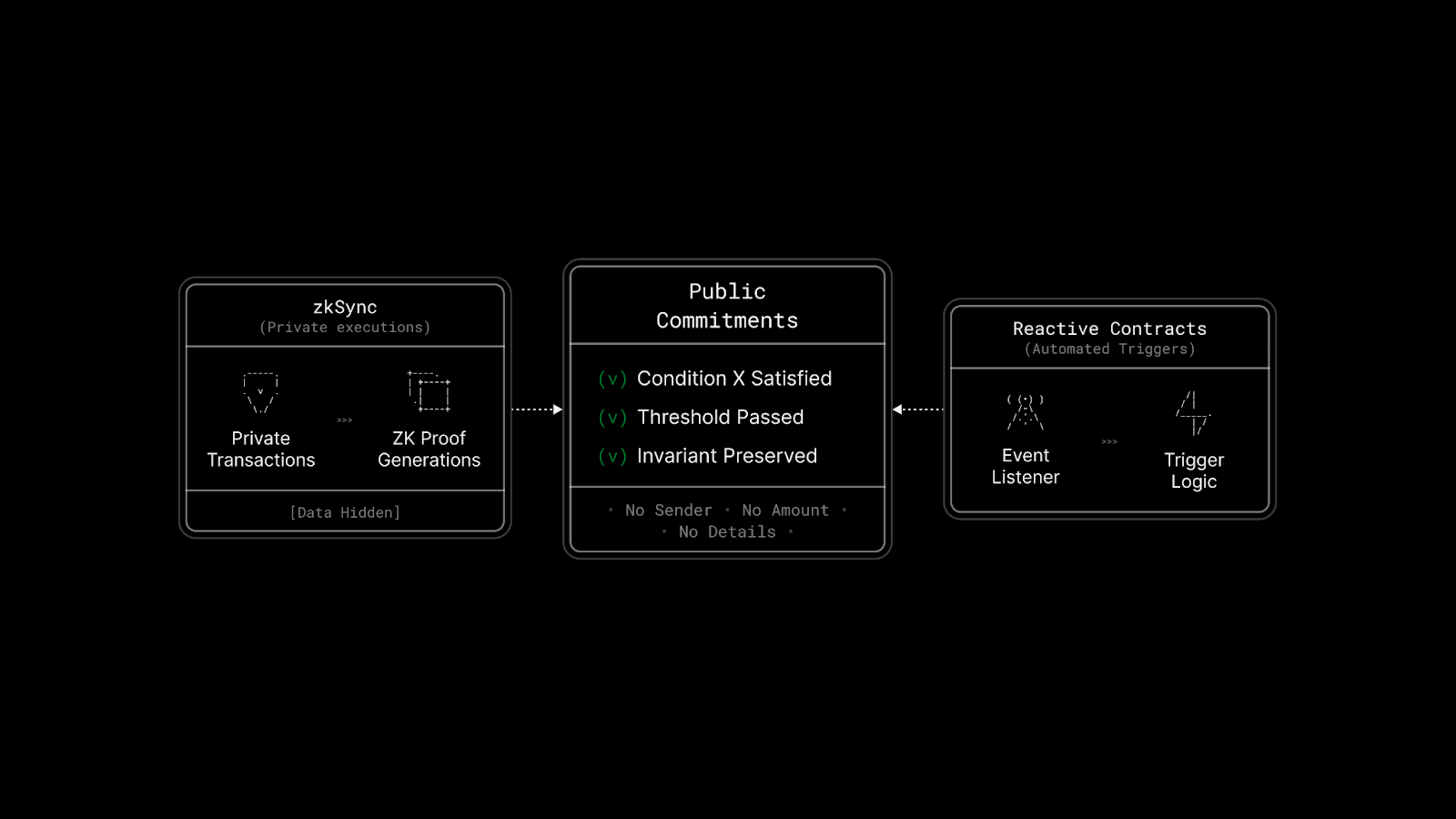
Reactive Contracts can subscribe to these signals and trigger logic without ever knowing who, how much, or why.
More advanced patterns emerge naturally:
- Selective Disclosure Schemes: ZK proofs reveal only the predicate Reactive logic depends on, such as “balance > threshold”, while keeping the exact balance hidden.
- Two-Tier Architectures: Sensitive computation remains private inside zkSync, while explicitly designed public hooks expose aggregated or anonymized state transitions for Reactive monitoring.
In this model, zkSync doesn’t become opaque, but instead becomes intentionally legible in just the right places.
Engineering Friction
Of course, synthesis comes at a cost.
ZK proofs take time to generate, while Reactive Contracts are, by nature, time-sensitive. Latency becomes a design parameter. Proof verification may need to happen on-chain or via pre-validated attestations. Cross-chain finality must be carefully aligned: Reactive logic needs to know when a zkSync event is final enough to act on.
These aren’t philosophical blockers. They’re engineering tradeoffs. Hard ones — but no deal-breakers.
Bigger Impact
If these compatibility layers mature, we get something rare in blockchain design: privacy-preserving automation across chains.
Today, builders are forced into extremes. Either full transparent systems with maximal composability, or privacy-centric systems that live in isolation. zkSync and similar ZK rollups already challenge this dichotomy by offering scalability and privacy. Adding Reactive Contracts pushes it further toward systems that can act without seeing everything.
This mirrors the real world. Banks, hospitals, and governments operate on the principle of “only what’s necessary.” They don’t need full visibility — only relevant facts. Blockchains, historically, haven’t supported this nuance. They default to radical transparency or sealed privacy silos.
A stack combining Reactive Contracts and ZK tech hints at a more mature architecture: automated, cross-chain, privacy-aware, and capable of functioning on precisely the information it needs, no more, no less.
Recap
Reactive Contracts and zkSync can coexist, but only if both abandon absolutism.
The question isn’t whether Reactive logic can see everything, or whether ZK systems must reveal nothing. The real challenge is defining how much visibility is sufficient and how deliberately that visibility is exposed.
Their compatibility ultimately depends on a few concrete factors:
- Whether Reactive Contracts can verify or trust ZK proofs
- How much structured signal zkSync is willing to surface for automation
- Cryptographic designs that support selective transparency by default
This is a spectrum of tradeoffs rather than a binary choice.
More automation demands more signals. More privacy restricts what can be signaled. The art lies in the balance that fits the system you’re trying to build.
About Reactive Network
Reactive is an EVM-compatible execution layer for dApps built with Reactive contracts. These contracts differ from traditional smart contracts by using inversion-of-control for the transaction lifecycle, triggered by data flows across blockchains rather than by direct user input.
Reactive contracts listen for event logs from multiple chains and execute Solidity logic in response. They can determine autonomously when to transmit data to destination chains, enabling conditional cross-chain state changes. The network delivers fast and cost-effective computation via a proprietary parallelized EVM implementation.
Website | Blog | Twitter | Telegram | Discord | Reactive Docs
Build once — react everywhere!