REACT Tokenomics: Network Stability & Longevity

Reactive Network is entering a new era.
The first version of REACT tokenomics was built around an Ethereum-style model: no fixed ceiling, validator rewards issued over time, and every network fee burned through real usage. The logic was coherent. It made sense for a young network still proving the shape of the protocol.
But Reactive is no longer a network run by a single team.
The code is opening. The stack is moving to CometBFT. Validators will secure the network directly. Governance is being phased in. The Foundation is taking on long-term stewardship. Builders, validators, exchanges and token holders now need something stronger than a model they have to interpret.
They need a model they can verify. So REACT is moving from open-ended issuance to a fixed supply model.
The maximum supply will be 2.4 billion REACT. Reactive Network’s move to Omni fork will mark the transition to open source model where all code and changes will be visible publicly.
This is not a cosmetic change. It removes discretion.
Under the old model, future validator rewards came from ongoing issuance. Under the new model, those future rewards are brought inside a fixed cap. No hidden mint path. No future supply curve to debate. No privileged key that can mint tokens later.
The point is simple: nobody should have to trust the team to handle future issuance responsibly.
Why the number is changing
The original public tokenomics used a 500 million launch supply and an open-ended validator reward model.
That meant the network could issue new REACT over time to pay for security. The redesign changes that. Instead of leaving future emissions open-ended, the tokens needed for validator rewards, ecosystem funding and long-term contributors are now made explicit from the beginning.
That is the trade.
The fixed number is higher than the original launch supply because future network incentives are now inside the cap rather than outside it. The benefit is that every future allocation becomes visible, capped and scheduled.
We calculated these figures to ensure security budget, ecosystem growth, and liquidity for new and existing exchanges will be accessible whenever and wherever needed.
To be clear, existing holder balances will not change. No migration, swap, bridge, claim or wallet action is required.
What does not change
The fee burn stays.
Every protocol fee generated by Reactive Network is still burned permanently.
That part of the original design survives because it was the right part.
Usage will reduce total supply.
The difference is that the burn no longer has to outrun uncapped future issuance. Under the new design, total supply starts fixed and can only fall through burns.
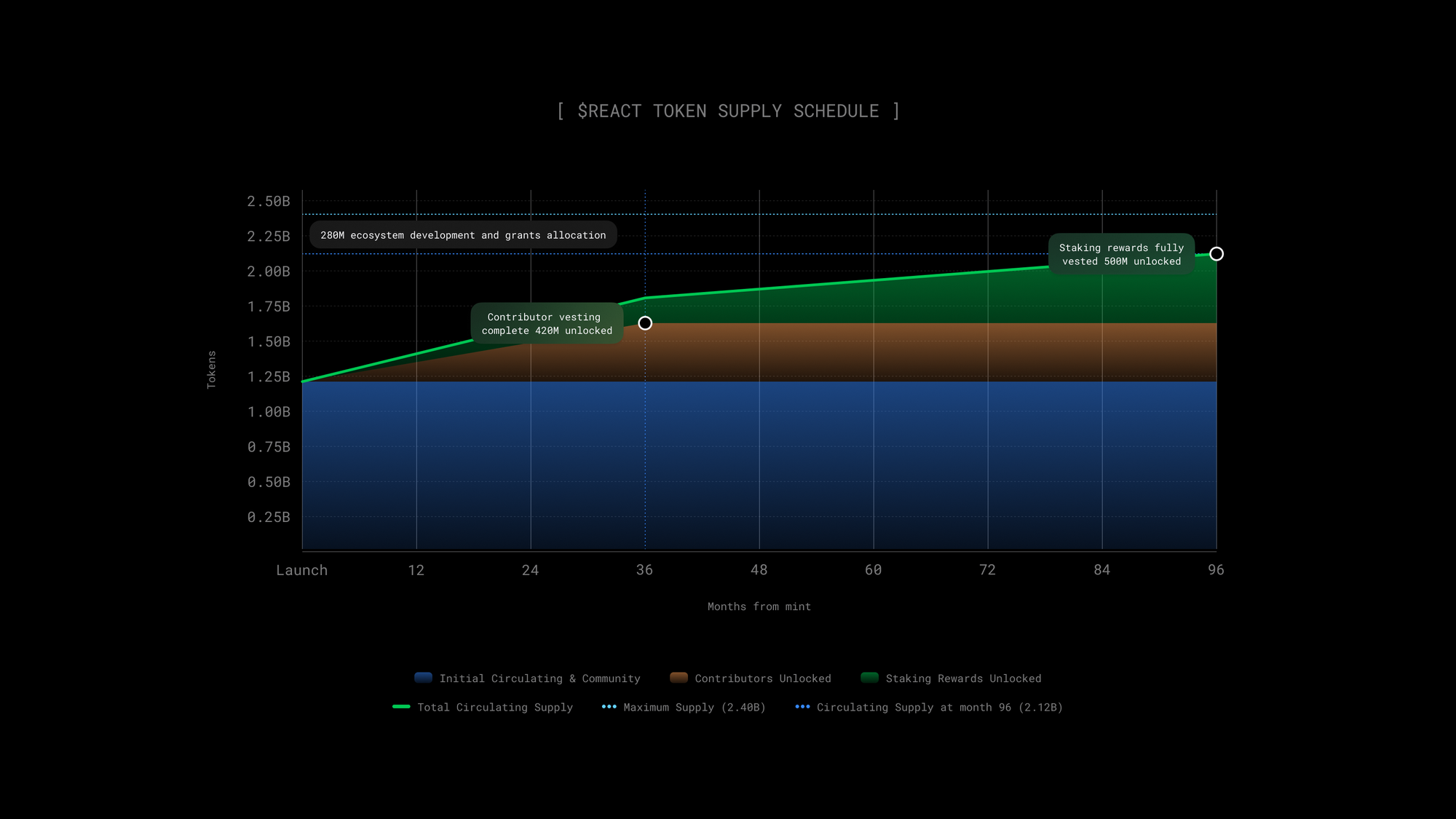
There is one important distinction. Total supply can only move down once the cap is live and minting is impossible. Circulating supply will still change as locked allocations vest. Those unlocks do not create new tokens. They release tokens from fixed, visible schedules.
Where the tokens go
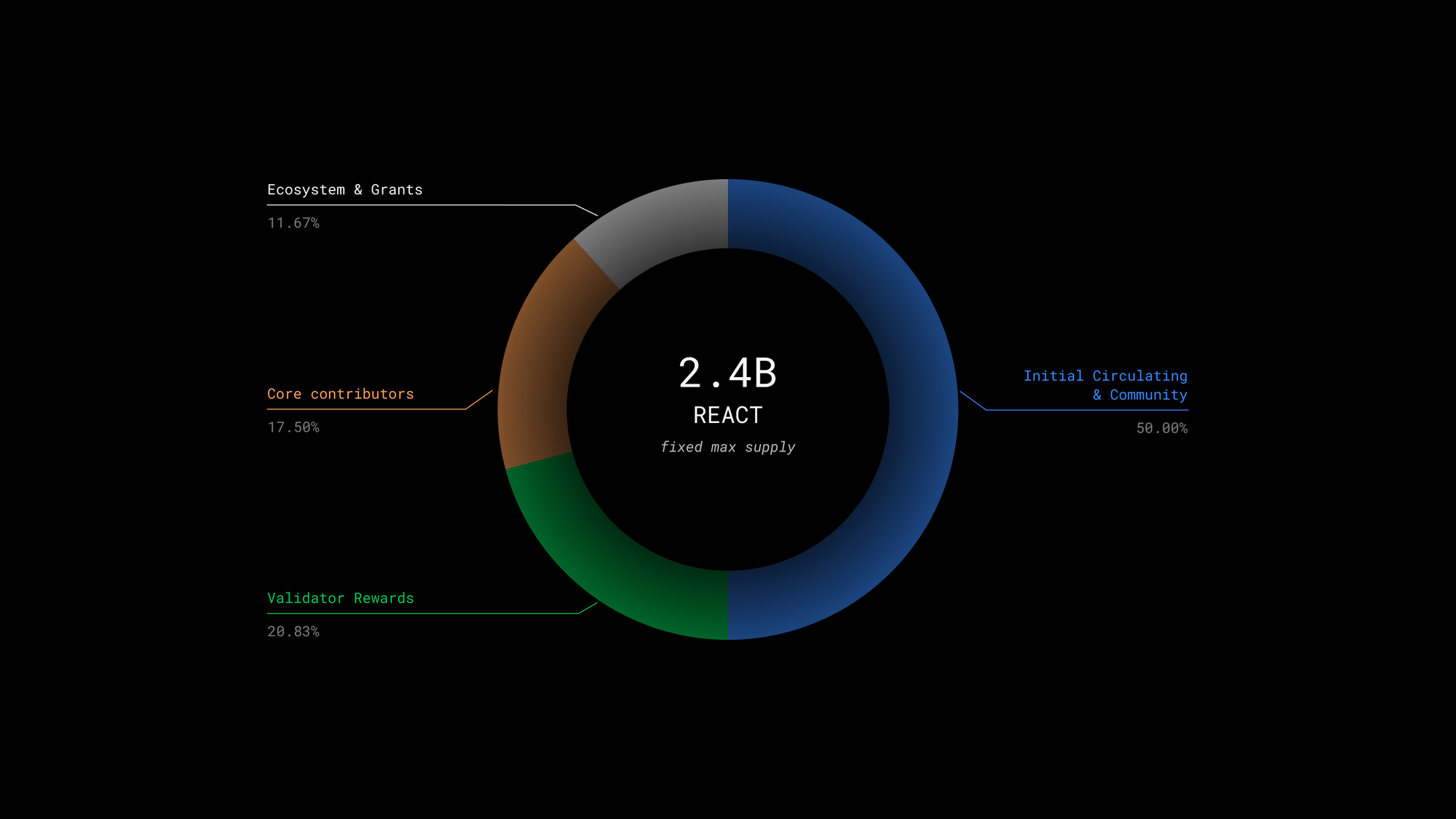
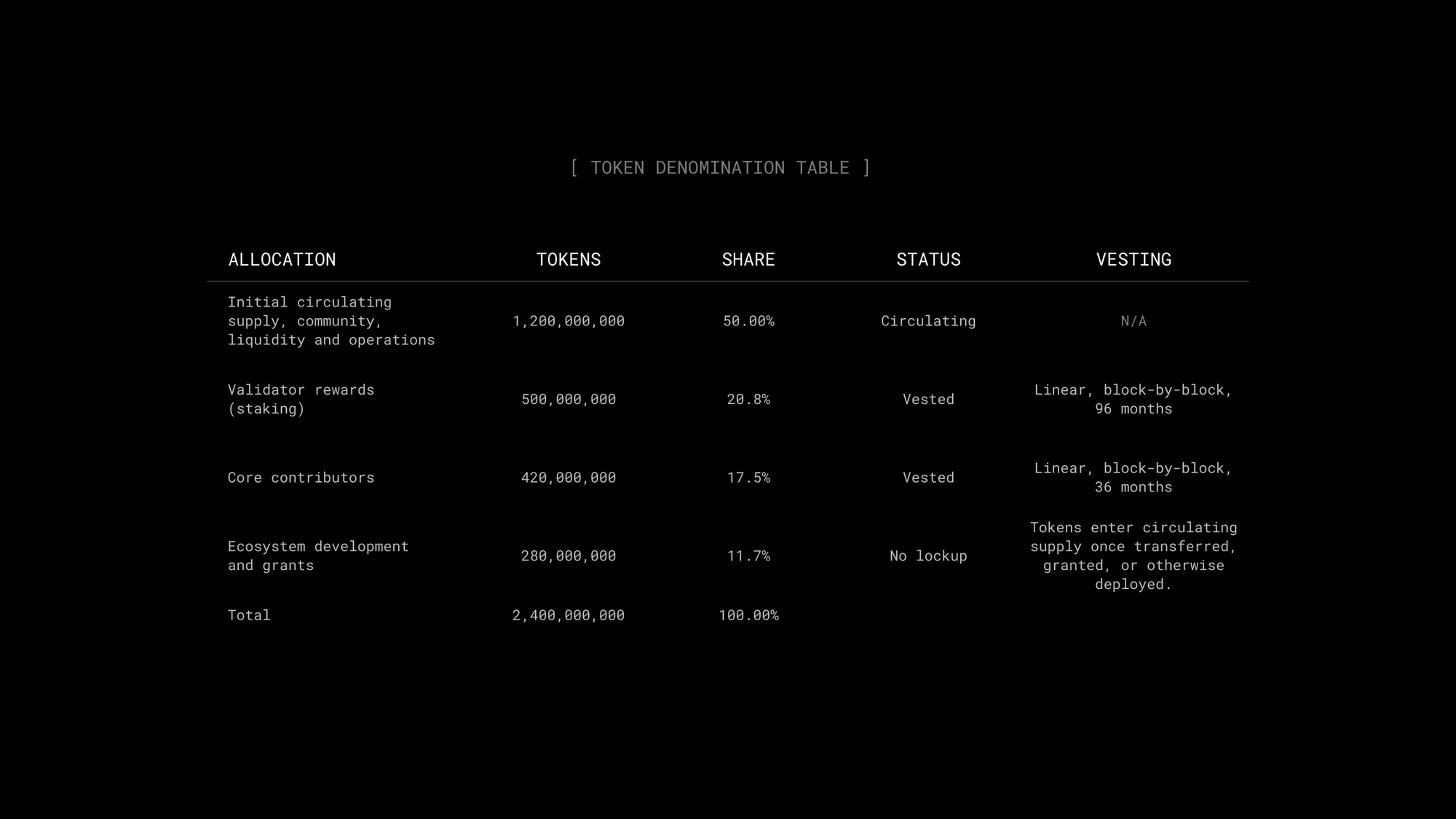
The fixed maximum supply is 2.4 billion REACT.
Locked Supply Wallets and Contract Addresses:
Validator Rewards: 0x30F4F134296b5698b05A799c3d56959Bb30Cf604 (These will be moved to contracts at Reactive Network Omni Mainnet)
Ecosystem Development and Grants: 0xA07d990c2cA0e26D0239cCcc92279a8f02b1901C
Core Contributors: 0x40d589db8c135602b836cbc14563f5a5b75ccbb1
The additional supply of circulating REACT gives access to tokens which may be required for the network to grow: liquidity across trading venues, inventory for new exchange listings and market-making, and reserve capacity for operational needs. REACT has to trade reliably enough for builders, users, validators and partners to access it without liquidity becoming a constraint as Reactive enters new markets.
Validator rewards
Validators receive 500 million REACT from a fixed allocation.
Validators and stakers will be paid from scheduled rewards paid from a pre-allocated pool. Validators secure the network, produce blocks, participate in consensus and support the move toward a more open validator set.
The schedule is intentionally long-term (96 months). Security incentives should not disappear after launch. Validators need a reason to stay aligned with the network over years.
At the end of the eight-year reward period, the allocation will be exhausted and no further REACT will be distributed from this pool. Validator compensation will then transition to the network’s fee market: a share of transaction fees will support validators, while a portion will continue to be burned. The objective is to move from a funded security budget to a network whose security is sustained by its own activity, without introducing further supply.
If you hold REACT, the goal is for staking and delegation to become part of the network’s security model. That does not mean every holder has to run infrastructure. Delegation gives token holders a way to participate in network security by staking, without operating a validator themselves.
The validator reward schedule begins at Reactive Network Omni mainnet launch.
Core contributors
Core contributors receive 420 million REACT.
This allocation exists because Reactive is not finished. The codebase is opening. The consensus layer is changing. Governance is being phased in. The developer experience has to improve. The network needs people who stay with the protocol through that work, not just through a launch cycle.
This pool will not necessarily be distributed in real time. The unlock schedule is linear block-by-block, but will likely be built up and distributed only when needed for specific strategic initiatives.
The principle is simple. Contributors should do well only if the network does well.
Ecosystem development and grants
The ecosystem allocation is 280 million REACT.
This is for the work the core team will not do alone: open-source tooling, developer grants, integrations, research, audits, infrastructure, documentation, community programs and applications built on Reactive.
As Reactive moves toward Foundation stewardship and phased governance, grants become part of the protocol’s growth engine. This pool exists to fund work that advances the network’s goals, strengthens the ecosystem and creates meaningful utility.
The dashboard
The tokenomics only matter if people can verify them.
Reactive public dashboard shows supply across chains, venues, vesting contracts, treasury wallets and allocation categories.
It also shows total supply, circulating supply, burned supply, locked supply, vesting schedules, allocation wallets, bridge or wrapped supply across supported networks, market-making or liquidity wallets, Foundation and grants balances, and all relevant contract addresses.
You can find the dashboard here: https://portal.reactive.network/distribution
Why this matters now
This change fits the wider Reactive roadmap.
The code is opening. The network is moving to CometBFT. Validators are being introduced. Governance is being phased in. The Foundation is taking on long-term protocol stewardship.
Each step moves Reactive away from a single-company network and toward infrastructure other people can inspect, secure and govern.
Tokenomics has to move with it.
An open validator set cannot rest on ambiguous issuance. Governance cannot begin with a supply model people have to interpret. Exchanges and data trackers should not be left deciding what maximum supply means. Holders should not have to ask whether future minting is possible.
The answer should be visible.
The only variable left
Reactive exists to turn event logs into programmable triggers. Contracts should not sit passively waiting to be called. They should react to the on-chain world around them.
The same standard now applies to REACT.
No mint path. No future issuance. No spreadsheets.
Fixed supply, visible schedules, permanent burn, and a network moving toward validators, open code and governance.
The economics are fixed, the only question left is what gets built.
About Reactive Network
Reactive Network is an EVM automation layer built around reactive contracts, event-driven smart contracts for cross-chain, on-chain automation. It runs on CometBFT consensus, providing instant finality and roughly 1-second block times while maintaining full EVM compatibility.
Reactive contracts subscribe to event logs across EVM chains and execute Solidity logic automatically when matching events occur, deciding autonomously when to send cross-chain callback transactions. This model supports conditional cross-chain state changes and continuous cross-chain workflows.
Website | Blog | X | Telegram | Discord | Docs
Build once — react everywhere!