Reactive Bounties: Second Bounty & Timeline

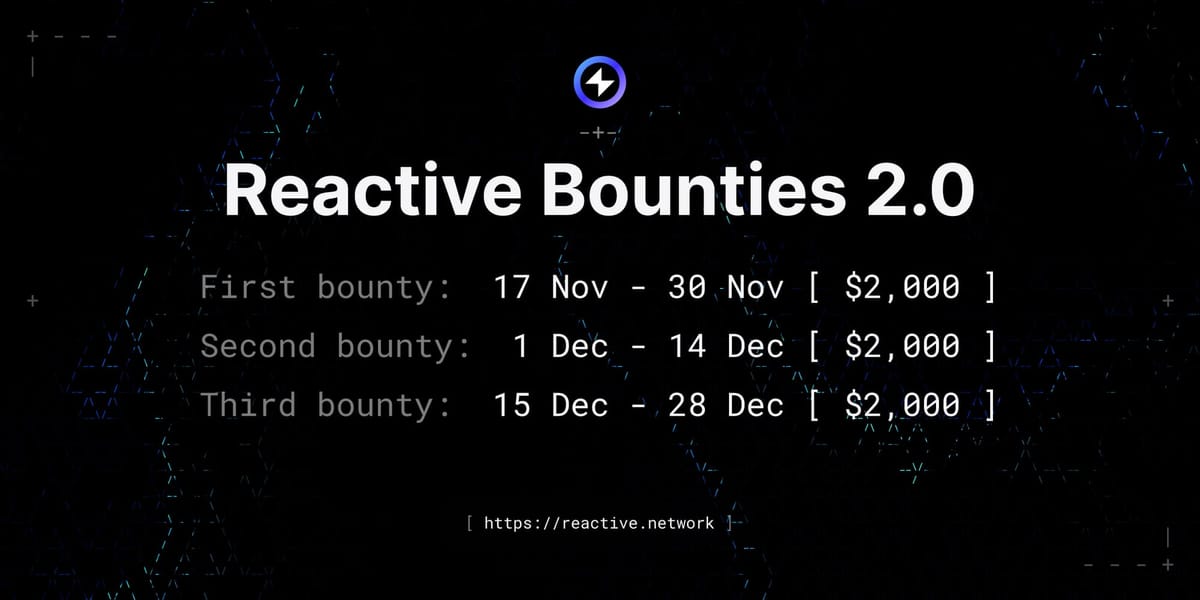
Our bounty program keeps rolling, on Sunday we closed submissions for the first challenge, a Cross-Chain Oracle. We received 23 submissions, and we’ll be reviewing them over the coming week. Huge thanks to everyone who submitted a build, it’s great to see so many engaged hackers and a lot of solid code. Now it’s time to announce the second bounty!
Second Bounty: Auto-Looper for a Lending Protocol
Build a simple leveraged “looping” strategy on top of an existing lending protocol using Reactive Contracts. When a user opts in, the Reactive contract should automatically perform several supply/borrow/swap steps to reach a target leverage, and optionally allow a safe unwind.
You can find the full details and requirements on the program page. The deadline is December 14, 11:59 PM UTC.
Note that, unlike most of our other challenges, this one is not primarily a cross-chain use case. It’s an automation use case, which means it works perfectly even within a single chain. Technically, the Reactive pattern is very similar, but the scenario can be especially interesting for dApps that currently live on just one network and still want powerful on-chain automation.
Timeline
To recap the timeline:
- The first bounty has just finished.
- We’re announcing the second bounty right now.
- This week we’ll be judging the first bounty and will announce the results in about a week.
- The deadline for the second bounty is December 14.
- After that, the third bounty will be announced.
Thanks for your participation - stay Reactive!
About Reactive Network
Reactive is an EVM-compatible execution layer for dApps built with Reactive contracts. These contracts differ from traditional smart contracts by using inversion-of-control for the transaction lifecycle, triggered by data flows across blockchains rather than by direct user input.
Reactive contracts listen for event logs from multiple chains and execute Solidity logic in response. They can determine autonomously when to transmit data to destination chains, enabling conditional cross-chain state changes. The network delivers fast and cost-effective computation via a proprietary parallelized EVM implementation.
Website | Blog | Twitter | Telegram | Discord | Reactive Docs
Build once — react everywhere!