Third Reactive Bounty: Winners Revealed

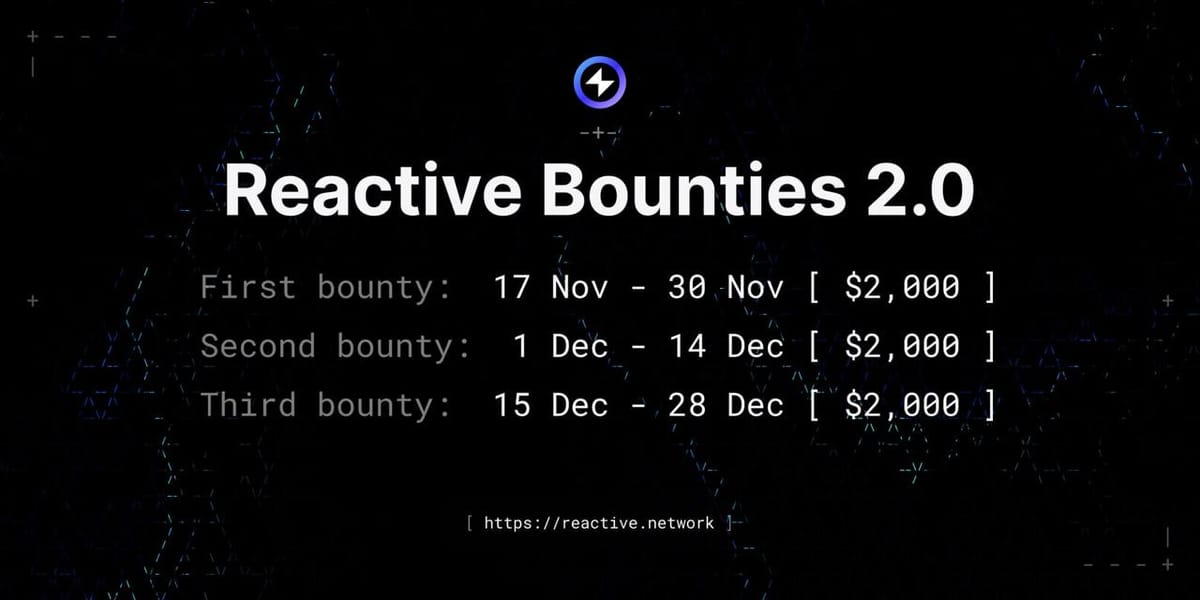
As of January 13, we’ve wrapped up all three Reactive bounty programs and what a run it’s been!
Across these challenges, builders pushed Reactive Contracts in different directions, explored new automation patterns, and shipped a lot of genuinely impressive code. Today, we’re excited to share the two winners of the third bounty, highlight a few honorable mentions, and close the loop by remembering the winners of the first and second bounties as well.
A huge thanks to everyone who took the time to experiment, build, and submit. The energy, creativity, and technical depth we saw throughout this bounty cycle made it clear that the Reactive model is resonating and that this community is just getting started.
Third Bounty Winners
The third bounty pushed Reactive Contracts into a very real DeFi problem space: automated yield optimization across chains. The submissions showed a clear step up in maturity. Less “toy demos,” more systems you could realistically imagine running with real value behind them. After reviewing all entries, here are the teams that stood out most.
First Place — 1,500 USDT in native REACT
Reactive Lending Vault goes straight after one of DeFi’s most frustrating realities: yields never sit still. Instead of forcing users to constantly monitor rates or trust off-chain bots, the vault leans fully into the Reactive model. Reactive Contracts listen to yield changes across chains and move capital automatically to where it works best, in real time. No keepers, no dashboards to babysit, just capital that reacts on its own.
Second Place — 500 USDT in native REACT
Zenith: Cross-Chain Yield Optimization Vault
Zenith takes a similarly pragmatic approach, but with a clear focus on production-grade DeFi infrastructure. Built with Reactive Contracts, it continuously rebalances liquidity between established lending protocols like Aave v3 and Compound v2 on Ethereum Sepolia. By replacing centralized automation with a trustless, event-centric pipeline, Zenith shows how Reactive patterns can support serious, hands-off financial systems without sacrificing transparency or control.
Honorable Mentions
Several other submissions came very close and deserve a call-out for strong ideas and solid execution:
Big thanks to everyone who participated in the third bounty. The quality and ambition of these projects make it clear that Reactive Contracts are quickly moving from experimentation to real-world DeFi building blocks.
Closing Thought
As we wrap up this bounty cycle, we want to give a final shout-out to all of the teams who helped shape it.
From the first bounty, projects like Echo and ReactiveAggregator showed how Reactive Contracts can power reliable cross-chain data flows, with several strong honorable mentions close behind. The second bounty raised the bar with more complex DeFi automation, and winners like Auto Looper and ReactiveLooper proved that fully on-chain, event-centric strategies are not only possible, but practical.
The third bounty continued that momentum, with Reactive Lending Vault and Zenith demonstrating production-minded approaches to cross-chain yield optimization, alongside a solid group of honorable mentions exploring similar ideas from different angles.
To everyone who participated, submitted, tested, or shared feedback — thank you! The creativity and technical depth across all three bounties made this program far more than a competition. We’re excited to keep building alongside you and hope to see many of these names — and new ones — show up again in future Reactive bounties.
Timeline
- 1st bounty — complete, winners announced, prizes distributed
- 2nd bounty — complete, winners announced, prizes distributed
- 3rd bounty — complete, prizes to be distributed
Good luck to everyone and run Reactive!
About Reactive Network
Reactive is an EVM-compatible execution layer for dApps built with Reactive contracts. These contracts differ from traditional smart contracts by using inversion-of-control for the transaction lifecycle, triggered by data flows across blockchains rather than by direct user input.
Reactive contracts listen for event logs from multiple chains and execute Solidity logic in response. They can determine autonomously when to transmit data to destination chains, enabling conditional cross-chain state changes. The network delivers fast and cost-effective computation via a proprietary parallelized EVM implementation.
Website | Blog | Twitter | Telegram | Discord | Reactive Docs
Build once — react everywhere!