Reactive Delegation

A blockchain is only as trustworthy as the people keeping it running. With Reactive Network’s move to CometBFT consensus, that job falls to validators and the REACT holders who back them.
Delegation is how any REACT holder can take part. You don’t need to run a node: back the network with your REACT and earn a share of what it pays out. Here is how it works.
Short Version for Newcomers
Reactive Network runs on proof of stake. Validators are the machines that produce and confirm every block, and each one locks up REACT as a security deposit. Do the job well, and the validator earns rewards. Cheat or go offline, and it loses part of that deposit.
You can back validators with your own REACT and share in what they earn, without running anything yourself. That is delegation.
Delegating REACT
Delegating takes one step: you deposit REACT into the Reactive Staking Pool, which opens once mainnet switches to CometBFT on Wednesday, October 28th. The pool does the rest. It spreads your REACT across several validators, collects their rewards and adds them back to the pool automatically.
In return, you hold staked REACT, a token that represents your share of the pool. There is nothing to claim and no button to press. Your amount of REACT stays the same, but each one is worth more REACT over time, so when you withdraw, you normally get back more REACT than you put in. Think of it as a fund that reinvests its own earnings: no payouts along the way, just a share that keeps gaining value.
Reading Dashboard
Everything happens in one place: the Delegate tab of the Reactive Token Portal. The page shows what the pool is doing as a whole, what your own position looks like, and which validators your REACT is working with. Here’s what each part means.
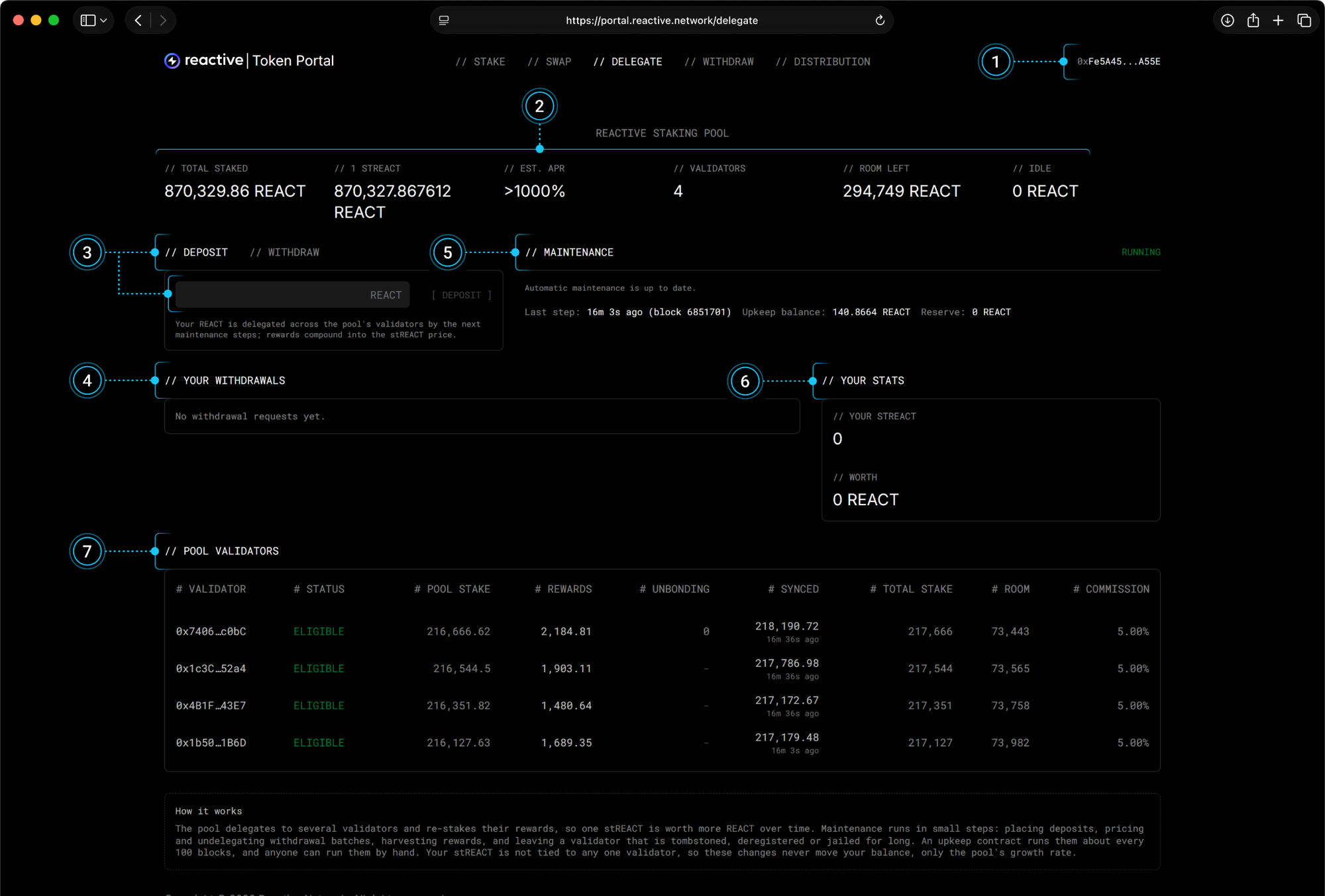
- Wallet. Connect your wallet in the top right corner. Your address appears once you’re in.
- Pool overview. These are live numbers for the whole pool:
- Total Staked is all the REACT in the pool, rewards included.
- 1 staked REACT is what one staked REACT is worth in REACT right now. This is the number that grows.
- Est. APR projects yearly returns at the current reward rate. It is highest when little REACT is staked and drops as more joins, so treat it as a snapshot, not a promise.
- Validators is how many validators the pool currently backs.
- Room Left is how much more REACT the pool can place before its validators hit their stake caps.
- Idle is REACT that has been deposited but not delegated yet.
- Deposit and withdraw. Enter an amount and press Deposit. Your REACT gets spread across the pool’s validators during the next maintenance step. To leave, switch to the Withdraw tab.
- Your withdrawals. Every withdrawal request appears here, so you can follow it until it’s ready to claim.
- Maintenance. The pool runs itself in small steps: placing deposits, processing withdrawals, collecting rewards and dropping validators that misbehave. An upkeep contract triggers these steps roughly every 100 blocks, paid from the upkeep balance shown here. Anyone can also trigger them by hand. “Running” means everything is on schedule.
- Your stats. This shows how much staked REACT you hold and what it’s worth in REACT today.
- Pool validators. This table lists every validator the pool backs:
- Status shows whether the validator is in good standing.
- Pool Stake is the pool’s REACT sitting with that validator.
- Rewards are earned but not yet collected into the pool.
- Unbonding is REACT on its way out for withdrawals.
- Synced is the pool’s position at its last update, and how long ago that update was.
- Total Stake is all the REACT on the validator, from the pool and elsewhere.
- Room is how much more the validator can take before hitting its cap.
- Commission is the validator’s cut of rewards.
Reward Distribution
Rewards come from a fixed budget: 500M REACT set aside for staking and paid out gradually over 8 years, a little less each year. With every new block, part of that budget goes to the validators that helped produce it. Each validator keeps a cut, called commission, and shares the rest with everyone who backs it, including the pool.
The pool charges no fee of its own. How much you earn depends mostly on how much REACT is staked overall. Everyone shares the same rewards, so the more people stake, the smaller each person’s slice.
Withdrawals
You can withdraw at any time, but not instantly. It takes a little over a week. Requests are processed in batches, which takes a few hours, and then there are about 7 days while your REACT is released from the validators. After that, you claim it.
Rewards stop the moment you ask to withdraw, but penalties still apply during the wait. That keeps things fair for everyone who stays: nobody can collect extra rewards on the way out or slip away before a loss.
If you hold REACT and want to earn while supporting the network, the Reactive Staking Pool is the simplest way in. It takes one deposit, compounds automatically and spreads your risk across several validators. The more REACT stands behind honest validators, the harder it is to attack the network. More on running a validator of your own will follow soon.
About Reactive Network
Reactive Network is an EVM automation layer built around reactive contracts — event-driven smart contracts for cross-chain execution. It runs on CometBFT consensus, providing deterministic finality with roughly one-second block times while maintaining full EVM compatibility. Reactive contracts subscribe to event logs across EVM chains and execute Solidity logic automatically when matching events occur, issuing cross-chain callback transactions when their conditions are met.
Website | Blog | X | Telegram | Discord | Docs
Build once — react everywhere!